

Data centers are talking to the Golden Triangle Development LINK every day.
After Meryl Fisackerly shared this simple, but true, statement at a Columbus Exchange Club meeting in August, the CEO of the region’s economic development arm caught hell for it.
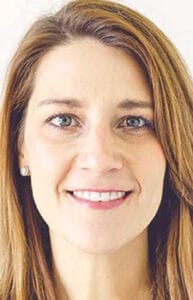
“I got threatening emails (after it was reported),” Fisackerly told The Dispatch Wednesday at her office near Golden Triangle Regional Airport. “… I’ve got people telling me they’re going to show up at my doorstep, and I’ve got three kids. I don’t need somebody egging my house or burning a cross in my yard because I’m working a data center. That’s the situation that unfortunately … the LINK has gotten into or the communities have gotten into.”
But Fisackerly insists the LINK is not recruiting or marketing to “data centers” – which can range from small crypto-mining spaces to hyper-scale centers used for cloud storage or artificial intelligence. It is vetting data centers “like any other industry.”
“It’s a normal economic development job in an environment where data center developers are now one of the many types of industrial developments and prospects that we’re seeing,” she said.
Still, those developers are calling daily, pitching projects that range widely in investment and footprint, carrying the potential of anywhere from 30 to 500 jobs, Fisackerly said. The Tennessee Valley Authority, the power supplier for much of North Mississippi, now has a dedicated data center development team due to the rise in inquiries it is receiving.
All of this comes in the face of rising public backlash to data centers generally, especially after the development of Elon Musk’s xAI plant in De Soto County that started in 2025 and is now facing a class-action lawsuit, primarily citing environmental and noise concerns.
Armed with plenty of industrial real estate in Lowndes, Clay and Oktibbeha counties, including the TVA-certified CINCO Megasite on Highway 82 across from the regional airport, Fisackerly does not rule out a large data center landing in the Golden Triangle. The developers that have approached the LINK so far, she said, aren’t “quite far along in their process to do it.”
“Are you asking will we ever get a hyperscaler? That’s not off the table,” Fisackerly said, in response to why The LINK hasn’t already landed a major data center project. “It’s just, you haven’t gotten one yet. There’s really no magic answer to that. Same reason why you don’t have an end user on CINCO. Somebody just hasn’t pulled the trigger on it.
“… The LINK is in the game of economic development, and a data center is considered economic development when you look at job creation and increasing your tax base. No ifs, ands or buts about it,” she added. “… I mean, is this community open for business?”
What are data centers?
Data centers are simply buildings that house internet-connected computers.
The hundreds – sometimes thousands – of computers running around the clock require large amounts of electricity for cooling. That power can either be generated on-site – like with the xAI power plant in Southaven, or drawn from the grid – like with Amazon Web Service’s facilities in Madison County.
Data centers also use water to cool equipment, typically by circulating it through cooling systems or evaporating the water into the air to dissipate heat. Many use reclaimed or recycled wastewater or operate a “closed-loop system.” Others continually pull water from aquifers.
ABI Research, a global technology intelligence and market advisory firm, reports there were nearly 2,400 data centers operating in the U.S. last year, with AWS owning the most. Other leaders in the hyperscale market include Microsoft, Meta, Google and Oracle.
Those companies have dedicated teams for finding sites to locate data centers, Fisackerly said. Third-party developers that build data centers on spec are a different story, she said, and are likely unviable partners for the Golden Triangle.
‘Send ‘em to me’
Joey Deason, executive director for the Madison County Economic Development Authority, parks his pickup in front of a fence overlooking the Entergy-certified Madison Megasite outside Canton.
Behind him is an Amazon Fulfillment Center. To the north, a Clark Beverage Company plant.
Neither is the purpose of the stop.
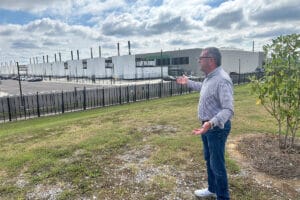
“Let’s listen to the big, bad data centers,” he told a Dispatch reporter along for the ride before walking up to a fence overlooking five operational AWS data centers.
Whatever noise the data centers make is drowned out by the traffic buzzing by on Nissan Parkway.
“It’s literally a non-event,” Deason said. “I don’t understand what all the complaining is about.”
Those five AI data centers are part of the first phase of AWS’s planned $21 billion investment in the county, which will build 34 data centers total – 17 each at the Madison Megasite and at another campus in Ridgeland over the next decade. The project will add $100 million in new ad valorem revenue to the county’s coffers annually in just the first phase, with that figure rising to more than $200 million once the buildout completes. Madison County, alone, approved a budget of $213 million for Fiscal Year 2027, compared to $130 million five years ago.
“That’s roads, parks, bridges, infrastructure, new practice facilities for the football team, a new school,” said Deason, who cut his teeth for four years working for the LINK before taking his role at MCEDA in 2017. “… In my opinion, it’s a perfect fit for the Golden Triangle.”
When AWS started building its data centers in 2023, no one really complained, save for the residents of neighborhoods adjacent to the construction site, Deason said. After Musk’s controversial buildout in Southaven, that changed.
Since then, he’s heard it all: Data centers are bad neighbors. They don’t create enough jobs. They use too much power and water. They make too much noise.
The reality in Madison County, Deason said, is very different. AWS has already hired 750 employees of a planned workforce of 1,700 for its campuses there, with 60% of the hires so far being Mississippians.
Noise is held to 50 decibels, or what Deason said is “about the volume of a normal conversation.” Since the first centers have come online, the city of Ridgeland passed an ordinance requiring future data center developments to follow those same standards.
AWS uses reclaimed wastewater to help cool its centers, usually in the hottest months of July and August. The rest of the year, it uses alternative methods, such as air and other liquid coolant. Even at that, their annual water use has dropped from 179 million gallons in 2023 to 83 million gallons now.
Their power use, Deason said, is “confidential,” though he admitted they are “large power users” hooked up to the Entergy grid. Still, AWS has heavily invested in improving the grid, even replacing an old Entergy power station to keep those costs from passing onto the customers.
Moreover, Deason insists, AWS pays for its own power.
“I’m telling you it doesn’t make any noise,” Deason said. “I’m telling you it uses less water than three golf courses. … I’m telling you the data centers are paying for the power. You’re not. … And it’s quieter than a steel mill, I can tell you that.”
Possibly the most compelling case for AWS data centers, Deason said, not a single homeowner near at least the Madison Megasite has put up a “For Sale” sign in the last three years. In fact, he argues those home values are likely rising, if Loudoun County, Virginia, is any proof. There, where there are 328 operational data centers and 48 under construction, neighboring home values have skyrocketed, he said.
Still, Deason knows a data center development won’t come with community consensus, especially with such a negative public narrative forming around them.
“Do you hold a town hall? Probably not. … You work with your elected officials. You work with your private partner, like the LINK. That’s the core,” Deason said. “… If it’s specific to a neighborhood, you work with the neighborhood. … If I had to answer every single social media post that was negative, I wouldn’t get anything done.
“… In your community, you have the right to say no, … for whatever reason, but at least get your facts straight,” he added. “Then if you still don’t want them, God bless you. Send ‘em to me.”
Gamechangers or mouse traps?
A crypto-mining center trying to locate on Industrial Park Road in Starkville met substantial crowds during public hearings this summer at City Hall. None were there to offer support for the project.
Instead, they asked questions about resource use, pollution, scale, whether the noise would harm animals housed at the nearby Oktibbeha County Humane Society shelter.
For each question, no answer followed that satisfied the masses, and the Planning and Zoning Commission denied the company the special permit it needed to operate a crypto-mining center. The board of aldermen later ratified the decision.
“The crypto center did set a tone because, for whatever reason and I don’t agree with it, there was some sort of moral outrage about crypto, and to me, it is a business to be abused or used properly like any other business,” Mayor Lynn Spruill told The Dispatch. “Now did they make their case? No.”

That tone, Spruill said, could also color how residents view future data center developments of any stripe or scale, which she finds unfortunate. For one, there are already four data centers on Mississippi State University’s campus that have neither garnered nor earned any pushback. That’s to say nothing of growing consumer habits that make data centers necessary.
“If you use Google or you use a chatbot, which people are doing daily, then you are using what this is providing to you,” Spruill said. “So I think it’s incredibly short-sighted for us not to look at them on an individualized basis. … I think they serve a purpose, and I would certainly hate that they don’t even get a fair hearing because of the, I guess, abuses that are occurring in other locations that’s spilling over into the concept in its entirety.”
The kind of investment they bring can be a “gamechanger,” Spruill said, and she would love to land one, especially at the NorthStar Industrial Park off Highway 389, where there is 30 megawatts of unused power available – enough to support a large regional facility but not a hyperscaler.
Spruill believes the city’s special permit requirement for data centers, as well as noise limits and other requirements contained in its Unified Development Code, are sufficient to vet for and regulate “good neighbors.”
She expects the LINK would bring projects worthy of consideration, in any case.
But Trip Hairston, president for the Lowndes County Board of Supervisors, doesn’t believe the CINCO Megasite is the best place for a large or hyperscale data center. He’s not even sure the Golden Triangle is the best fit.
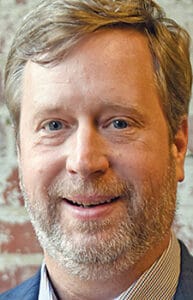
Those data centers require internet infrastructure not available in this area. While Lowndes County typically builds out utilities like power, water and sewer for locating industries, Hairston does not believe the county should do likewise for internet needs for data centers, an industry he called “mouse-trap dependent.”
As technology changes, he explained, once large facilities get smaller, it could cause hyperscale data centers to constrict and empty over time.
“I may be wrong (but) I think the mouse trap is going to change,” Hairston said. “I think that the chips are going to improve, that they will find ways to put these things maybe in space, in a different way that doesn’t upset communities the way they’re being upset now with just the very thought of them.”
“Most people will say, ‘Hey, let’s take the good while we got the good, and not worry so much about the bad.’ And there’s nothing wrong with that thought process at all,” he added, noting he would not ‘stiff-arm’ a billion-dollar investment without a fair hearing. “But when it comes down to spending a bunch of money to put the infrastructure in to attract the data center, that’s a whole different story.”
Josh Hendrickson, chair and professor of economics at the University of Mississippi, said data centers and modern manufacturing facilities have complementary infrastructure needs, meaning investments made to support one may also attract the other.

“Furthermore, because data centers are large and able to support a great deal of weight, the facilities themselves can be adaptable to other uses in the event that technology changes, or the data center leaves and shuts down,” he wrote in an email to The Dispatch.
Hendrickson said he’s been surprised to see how little some data center developers appear to be doing to build goodwill with communities where they locate.
“An older generation of industrialists tended to attenuate these concerns by investing directly in the community by funding a new library for the local high school and/or sponsoring the local football field to provide resources for upgrades and maintenance,” he said.
Those investments ensured communities that a company’s commitment wasn’t fleeting, Hendrickson said.
“I’m not saying that is what these companies need to do now or what should be expected of them,” he said. “However, I’m surprised they are not doing things like this to generate goodwill given the recent backlash and concerns.”
Too much to bear
Taylor Logsdon used to host weekly get-togethers in the backyard of her Southaven home, where her family has lived for nearly 11 years.
But now Logsdon said the noise from a hyperscale data center owned by xAI and the power plant acquired by the company to power it, both located about 0.3 miles from her backyard, have become too much for the family to bear.
What started as “annoying” but tolerable construction noises escalated to a constant buzz after more than 40 gas-powered turbines were installed at the plant to replace previously unpermitted turbines. The noise started keeping her family awake at night, and Logsdon said her kids can’t play outside for long before developing a headache.
Logsdon and other residents living near the data center formed the Safe and Sound Coalition, which advocates for “clean air, quiet nights, responsible growth and honest leadership.” She and other residents have even filed a class action lawsuit against xAI, alleging “combination of high-pitched squealing, continuous engine roaring, low-frequency rumbling and tonal humming” has degraded their quality of life.
“We are hoping that we can enjoy our properties again, like the ways that we used to,” Logsdon said of the lawsuit.
Despite her experience, Logsdon doesn’t believe all data center developments are bad. But she said officials have to include community members in the process of considering whether a data center is the right fit for a community.
For example, when a conditional use permit was approved for a data center in St. Louis earlier this year, the city set a number of conditions for the development aimed at addressing concerns raised by residents, including requiring a closed-loop system to minimize water consumption and at least 50% of the energy load needed for the facility coming from renewable sources within five years, according to a city press release issued in April.
The city also negotiated a community benefits agreement with the developer, backed by financial penalties, wherein the company will meet escalating job growth minimums for 20 years and contribute an estimated $15 million to a city fund to use for multi-modal enhancements and economic and environmental justice activities, among other things.
“I would definitely (recommend looking) into the aspects of what kind of data center it’s going to be,” Logsdon said. “They need to know about how much water they’re going to be using, if they’re bringing power or hooking up to a grid. Those are big questions that need to be asked.”
You can help your community
Quality, in-depth journalism is essential to a healthy community. The Dispatch brings you the most complete reporting and insightful commentary in the Golden Triangle, but we need your help to continue our efforts. In the past week, our reporters have posted 33 articles to cdispatch.com. Please consider subscribing to our website for only $2.30 per week to help support local journalism and our community.