
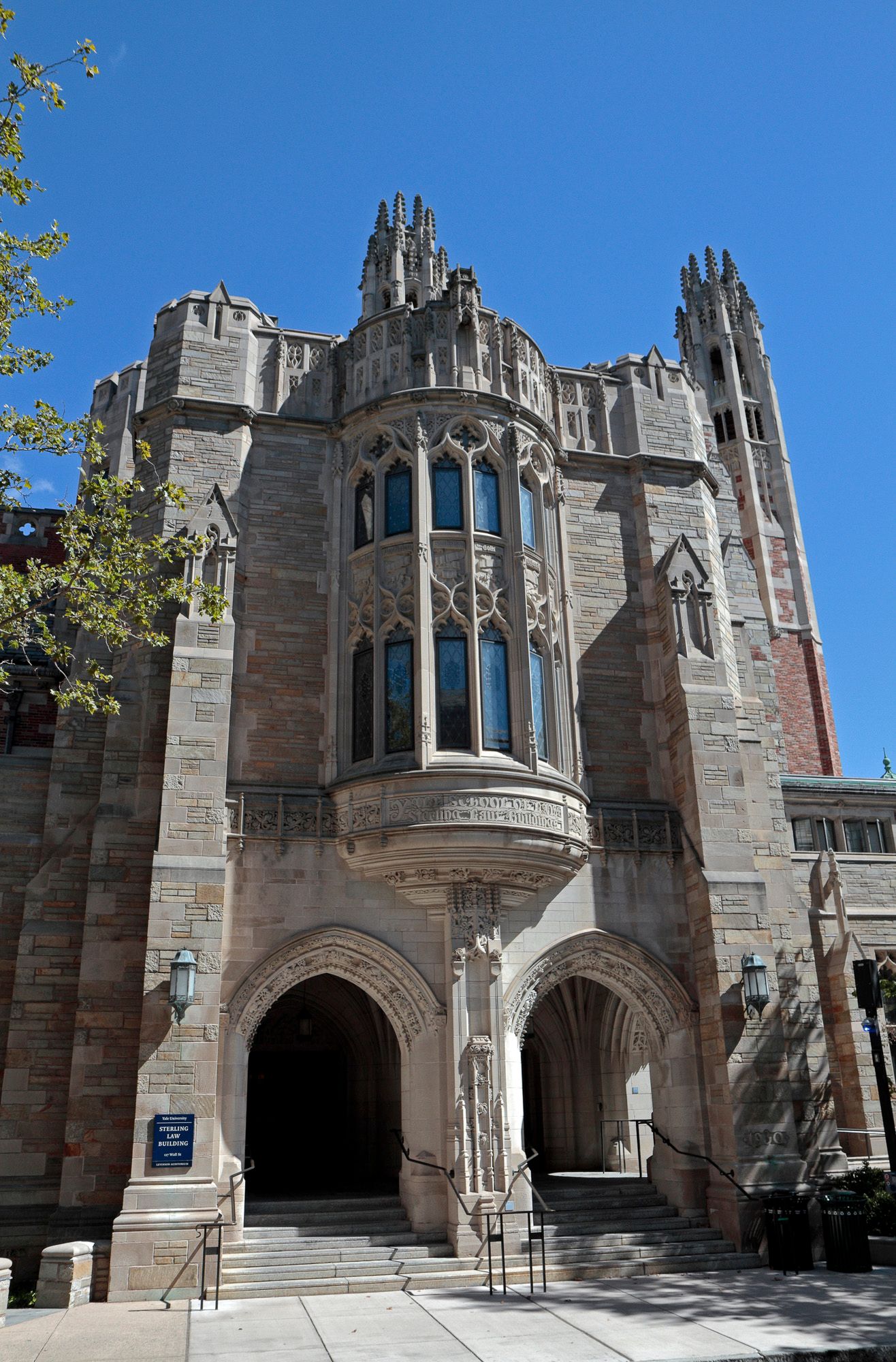
In the fall of 2010, on the first floor of the Sterling Law Building, a neo-Gothic edifice in the heart of Yale’s campus, contracts class is underway. Nearly every seat is filled, and there’s a buzz in the air. That’s because Amy Chua, who teaches the class, is a magnet for some of the most ambitious students at Yale Law School. A petite, energetic Chinese American, Chua is known for her uncanny ability to place her top pupils in the most coveted jobs in the judicial firmament: clerkships with federal appellate court judges such as Brett Kavanaugh and Merrick Garland (many of whom are Chua’s good friends). It’s just one step from there to the holy grail for Yale Law grads: clerking on the Supreme Court.
Sitting in the front row, to Professor Chua’s right, taking notes, is a focused young woman, Usha Chilukuri. The daughter of first-generation Telugu Indian immigrants, she’s already been pegged as the brightest student in the class of 2013, possibly even a future president. (Hillary Clinton was the breakout star of the YLS class of 1973.) In the back row, to Chua’s left, is a beefy ex-Marine. Some classmates wonder if he’s cut out to be a lawyer, much less a future president. His name is JD Vance.
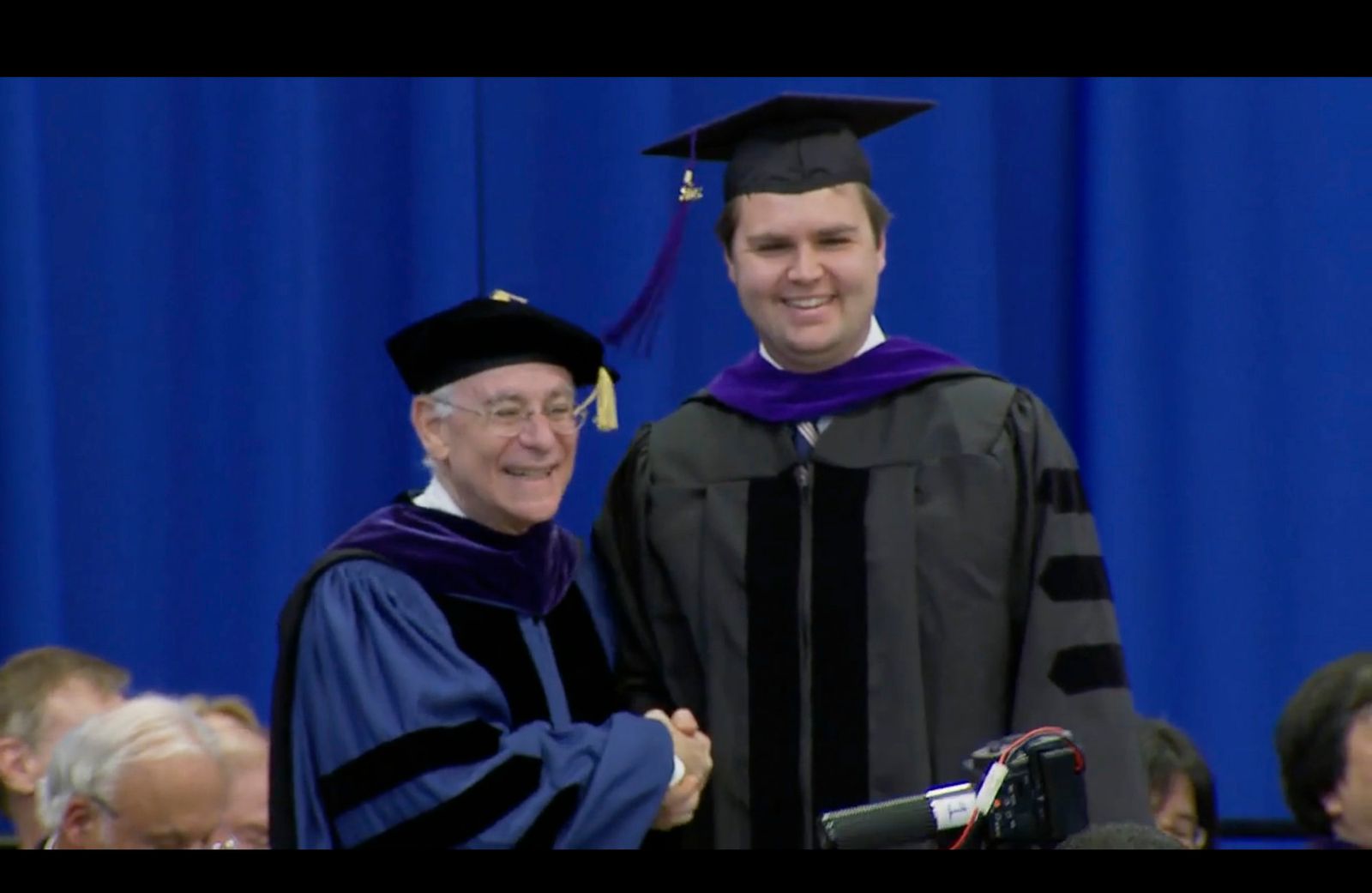
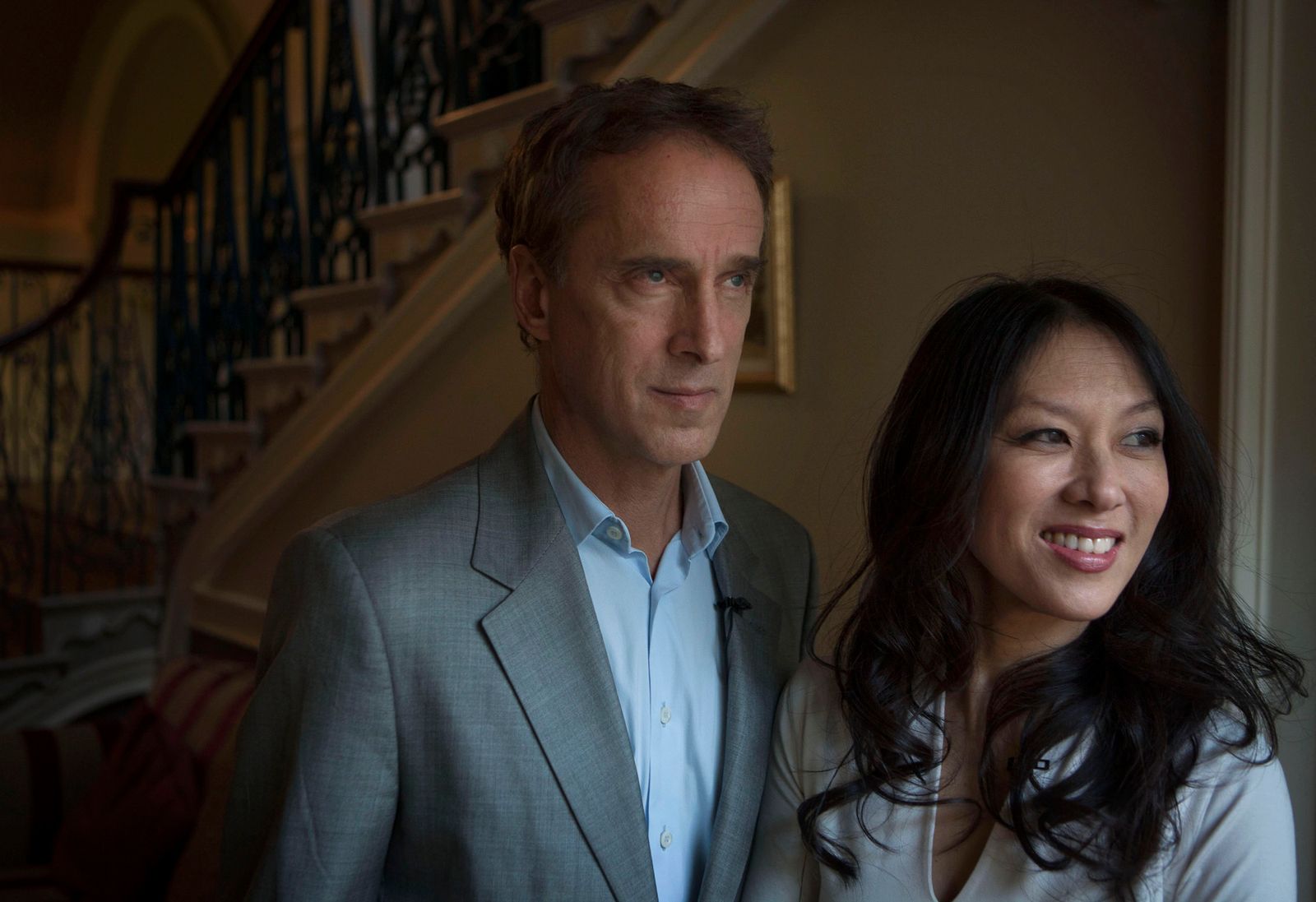
“He had, like, a pink or purple sweater,” Chua recalls. “He was not always that elegant.” But the professor saw potential in the rumpled first-year student from Middletown, Ohio. “I always thought he was destined for great things,” she tells me in an exclusive interview for Vanity Fair. Chua and her husband, Jed Rubenfeld, a YLS constitutional scholar, predicted that Vance would someday end up in the White House. But that was several years later—after Vance, with Chua’s help, had become famous.
A few months after that contracts class, Chua would publish Battle Hymn of the Tiger Mother, a book that became an instant bestseller and made her an international sensation with its tough-love message that parents should stop coddling their kids and proactively drive them to achieve their full potential. By 2016, under Chua’s tutelage, Vance would publish Hillbilly Elegy. That well-regarded account of Vance’s dysfunctional childhood and his hardscrabble Appalachian roots made him a phenomenon. Here was a freshly minted Yale Law grad who could explain the plight of the impoverished Rust Belt—and excoriate Donald Trump in the same breath. Vance said Trump could become “America’s Hitler” and, in an article for The Atlantic, compared him to “cultural heroin.” But then, in 2021, Vance made a head-spinning ideological about-face. He threw in his lot with Trump and his MAGA movement. The next year, with the ex-president’s endorsement, Vance was elected to the US Senate. He would become Trump’s running mate in 2024 and the favorite to become his party’s 2028 presidential nominee.
Ever since, Vance has been pilloried as a cynical political opportunist. “I don’t think JD Vance believes in anything,” says Stuart Stevens, who ran Mitt Romney’s 2012 presidential campaign. “I think he would be a Trotskyite if that would advance him.” But what does Vance’s mentor Chua think of his 180-degree transformation? “I have a very different view of JD,” she says. “I do not think he changed at all. I think he’s exactly the same guy.”
A close friend says that Vance has been ambitious and strategic from the get-go: “And if you’re not strategic, maybe you shouldn’t be in politics.”
Amy Chua sits in her office on the third floor of Yale’s Sterling Law building on a recent summer afternoon. Behind her, through an ornate window, are the classical slate-and-copper rooftops of Yale Law School. Chua rarely speaks publicly about her most famous pupil, and she’s excited, animated. Vance, the son of a drug-addicted mother and mostly absentee father, was an outsider at Yale, Chua says, just as she had been as a daughter of Chinese immigrants at Harvard Law. “I was very similar to him in law school. My parents are really smart, but they were not lawyers. My mom barely spoke English when they came here. I didn’t know anything—I didn’t even know there was a separate federal and state court system.”
Chua agreed to meet me after an introduction from a mutual Yale friend. (I’m a graduate of Yale College.) “I could speak two kinds of Chinese,” Chua continues, “but I didn’t know how to set a table. So I really related to JD.” She related to something else too: Vance’s big dreams. “I’m a law professor. But I’m also a talent scout. I love people with big dreams.”
To this day, Chua remains close with the vice president and second lady. How close? There are two people, says a friend of both, whose phone calls JD will invariably pick up. One is Trump; the other is Chua. Last April, after a would-be assassin was thwarted while storming the White House Correspondents’ Dinner, Vance texted Chua from a secure room at the Washington Hilton Hotel. (Usha, six months pregnant, was at home.) He had been whisked there by the Secret Service. The Tiger Mother, also an attendee that night as the guest of The Free Press, was in the main ballroom, awaiting the VP’s return.
Chua was at first reluctant to talk with me; indeed, few people associated with Yale appear willing to speak on the record about Vance. His detractors fear that opening up about him could invoke the Trump administration’s wrath. Since his return to power, Trump has slapped sanctions on Harvard, Columbia, Penn, Princeton, Cornell, and Brown. But Yale, until this summer, had largely avoided such unwanted attention. Why make waves, some ask, by potentially offending Vance? One professor suggests, half in jest, that Yale’s gotten off relatively easily thus far because Vance likes to visit his old stomping grounds: “He brought his kids just after he was elected and wanted to take them to all the places he used to go for pizza. So I was kind of hoping that would keep Trump from coming after Yale.”
Conversely, some of Vance’s allies worry that saying anything positive about him will make them campus outcasts. Yale undergraduates are predominantly liberal, a YLS professor insists, “and the law school is way more extreme.” Alarmed by reports that the university might agree to cut a “deal” with the Trump White House over alleged improper admissions practices, several students and law school faculty members are leading a campaign against such a settlement; they’d rather fight the administration in court. Indeed, from the moment Vance signed on as Trump’s VP in 2024, he’s been persona non grata to many of his fellow Yalies. Says one close law school acquaintance: “It’s Trump.” Both the vice president and second lady declined my request for in-person interviews. Offered a chance to comment on statements made about the VP and second lady in this article, Vance’s spokesperson, Taylor Van Kirk, responded to some queries, but not to others.
A roster of Vance’s YLS class might make you think the country’s run by an Ivy League cabal. Enrolled there, from 2010–2013, were Vivek Ramaswamy, a future presidential candidate, DOGE volunteer, and current candidate for Ohio governor; Elbridge Colby, now an undersecretary at the Pentagon; Michael Ellis, a CIA deputy director; and, of course, JD and Usha. Dan Driscoll, who resigned in September as Trump’s secretary of the Army, graduated in 2014. If Vance becomes president, they could constitute the nucleus of his cabinet. One wag calls the VP’s class “the bizarro world version” of YLS’s storied class of 1973, which included Bill Clinton, Hillary Rodham, Robert Reich (later Clinton’s labor secretary), and Richard Blumenthal (Connecticut’s senior US senator). Justice Clarence Thomas, ’74, was just one year behind.
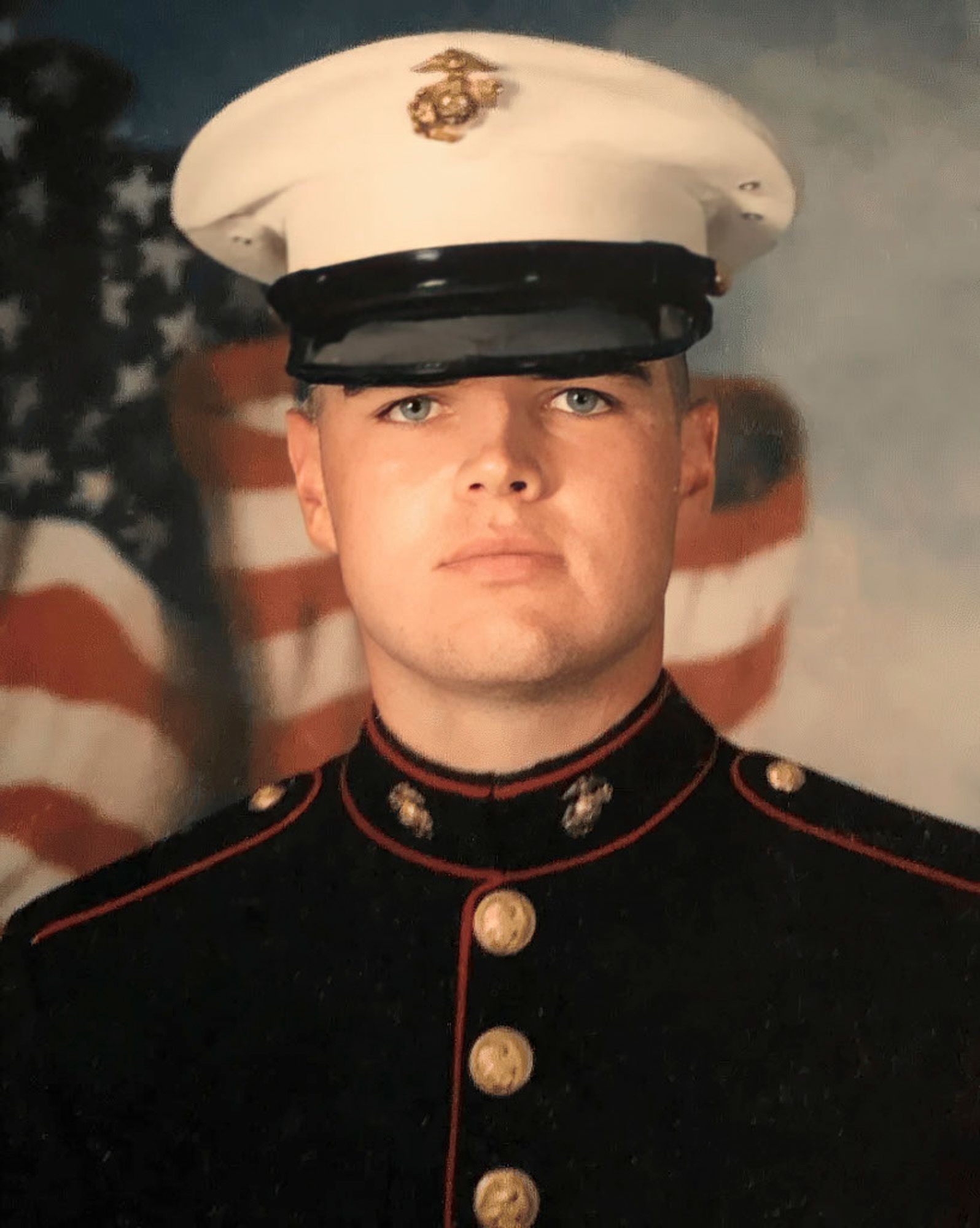
Vance arrived in 2010. He’d served in Iraq as a Marine public affairs officer and then earned a BA with honors from Ohio State. Yale was in flux, no longer a bastion for legacy students with names like Auchincloss and Vanderbilt. The YLS class of 2013 also included an unusually large number of US service members.
Vance and a small band of fellow vets would knock back beers in working-class New Haven bars. (The group tended to shun the tony old-school Yale dining establishment Mory’s.) He vented about the folly of the Iraq War. “He certainly had seen plenty of nasty stuff up close,” says a classmate who’d served in Iraq at the same time. “It didn’t matter if you were combat or non-combat, [you saw] roadside bombs, missiles flying into the Green Zone.” As a press officer in Iraq, Vance honed his ability to hedge the truth. “You’re trying to put a good gloss on what’s happening,” explains this classmate. “He probably didn’t agree with a single article or social media post that he wrote. But he probably wrote it better than anyone else and strongly got behind it. So that’s kind of who he is.”
At Yale, Vance was outgoing and popular. But he didn’t hide his contempt for the architects of the war. In class, one of his close friends recalls, when the subject turned to why the American-led coalition had invaded Iraq in the first place, he would say: “They were like, ‘Oh, oops, no weapons [of mass destruction].’ And it was my town that died. The people from towns like mine. They went off and they never came back. And they never said sorry.’”
While attending Chua’s contracts class, Vance signed up for her one-on-one office hours. Vance asked her, “Why are you so nice to me?” Chua was taken aback. “I later realized,” she says, referring to his dysfunctional childhood, “it’s his background. A lot of people weren’t nice to him.” Vance seemed adrift; he didn’t necessarily want a law career and wasn’t sure what he was doing there. “He was a real hillbilly,” says Chua. “He was often completely lost here. He was going to drop out 50 times.”
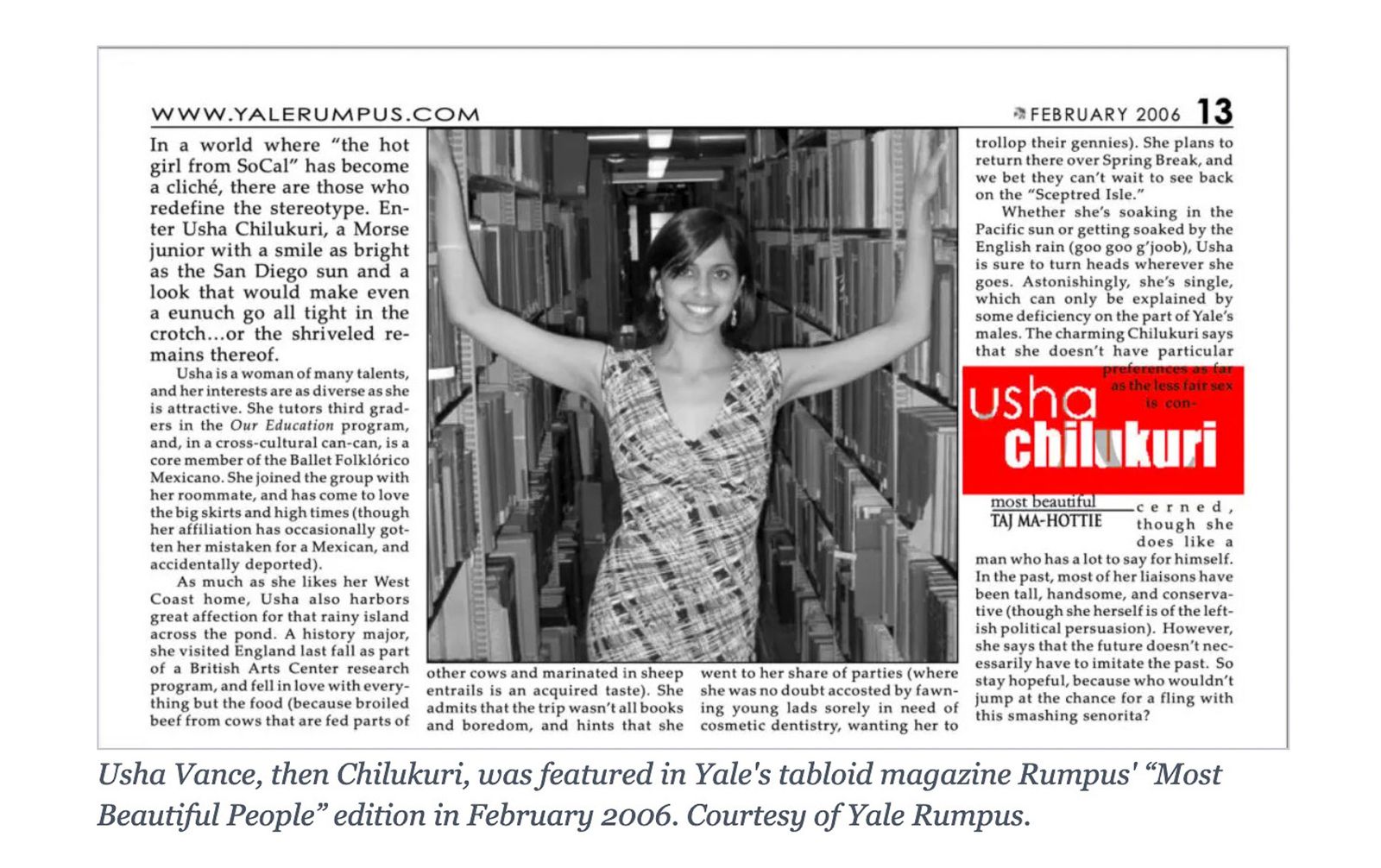
The standout of the YLS class of 2013 was Usha Chilukuri. “She was a rock star,” says a classmate.
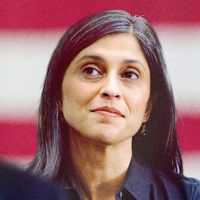
Usha’s desire to excel was unmistakable, but, to some, it wasn’t clear what drove her. Unlike many of her classmates, Vance would later write, Usha “couldn’t have cared less about running the world.” With a BA from Yale (summa cum laude) and a master’s from Cambridge, “she felt this pressure to keep chasing these gold stars, but it wasn’t real ambition,” says a close friend. “I don’t know if it came from her parents. Why did Usha need to clerk for the Supreme Court? I’m very ambitious. I never felt like I needed to clerk for the Supreme Court.”
Usha’s political views weren’t readily apparent. “She certainly came from a liberal political family,” says another friend, “but with small-c conservative philosophies about family and education.” Usha was cool, self-possessed—and disciplined. “With a glass of wine, Hillary and I could have fun,” says a Yale Law professor, referring to that other famous YLS alumna. “Usha won’t drink more than half a glass. She’s the only person I ever said, ‘Usha, you could stand to be a tad more ingratiating.’ Because she is a very chilly fish.”
Vance’s political ambition was plain as day. “I instantly saw it,” says a close friend. “I’m glad he didn’t lie. I’ve heard many podcasts where people asked him when he became senator or vice president, did you plan this? And I was like, ‘If he lies, I’m going to call him out, right?’ Because he always had that dream.” As for his politics, Vance was a mainstream Republican; he admired Mitch Daniels, the pragmatic and fiscally conservative GOP governor of Indiana and ex-director of the Office of Management and Budget.
Assigned with Usha to a 16-student study group, Vance was bowled over, falling hard for his classmate after they teamed up on a moot court project. Chua says: “I gotta tell you, Usha must have been 50 billion times better than he was at that assignment.” Usha, too, warmed up to Vance. “When he was a student and he was still struggling with his early issues, she was there,” Chua recalls. “She is capable of enormous warmth and love.”
Vance had a fiery temper and a short fuse. On occasion, he would have meltdowns when a professor gave Usha a questionable grade or if he felt condescended to. “He had a really big anger,” says a friend, “a strong conviction, which I now see as part of what he is—you know, not trusting these arrogant coastal elites that don’t care.” When a professor made disparaging remarks about students from state schools, this friend remembers, Vance, a proud Ohio State Buckeye, went ballistic: “He said, ‘I’m transferring, I’m dropping out.’ He was very drama queen.”
The drama queen in Vance was evident more than a decade later, the friend observes, when the vice president exploded at Ukraine president Volodymyr Zelenskyy in the Oval Office in February of 2025: “He’s not very good at BS, and you can tell he just didn’t like Zelenskyy. There are people he doesn’t like. He gets his back up.”
How in the world, wonder some of Usha’s law school pals, does she tolerate her husband’s current hardline political views? Usha is a US citizen, born to parents who emigrated from India. And yet Vance has supported Trump’s efforts to nullify birthright citizenship, mindful of the potential effect of such a move on millions of families. Is Usha troubled by this? (The Supreme Court, in a 6-3 decision, recently rejected the president’s repeal of the right by executive order.) Chua dismisses the narrative that Usha chafes at Vance’s political views, including his decision to run as Trump’s vice president: “He would never do anything if she was against it. This is another giant misunderstanding. When I read stuff out there, like there’s this whole conceit that it’s, ‘Blink twice if you’re trapped’ or something like that—she’s in prison, and she’s so terrified or whatever. That’s ridiculous. She’s incredibly strong and centered.”
.png)
What about Vance’s bogus charge about Haitian immigrants, which Trump repeated during a 2024 debate with Kamala Harris? “Are there moments for Usha,” I ask one of her close friends, “where she’ll say, ‘JD, eating cats and dogs? Are you kidding me?’” She replies: “I would say that there have got to be thousands of those moments, but they might not be the ones that we, the coastal elites, would think. Usha knows how much JD wants to be president someday. And so I think she’s just completely on ‘Team JD.’”
At Yale, Vance was searching for a greater purpose in life. As he writes in his book Communion: Finding My Way Back to Faith, published in June, he’d become an atheist in Iraq after the on-again, off-again Baptist and Pentecostal churchgoing of his youth. Vance hoped to rediscover some kind of spiritual or philosophical grounding. Like William F. Buckley Jr., Yale ’50, who wrote the seminal critique God and Man at Yale, Vance believed the university had become hostile to both religious faith and conservative ideas. While Buckley blamed this on Yale’s godless liberal faculty, Vance attributed it to a subtler but more potent “socialization.”
At Yale, Vance writes, “the groupthink pressure was incredibly powerful. In the early 2010s, we had not yet reached the peak wokeness of 2020, of corporate CEOs or professional athletes groveling before an offended mob. But I should have seen it coming.” As Vance saw it, students, believing in nothing else, were trapped on an unfulfilling academic and professional treadmill: “We fought over jobs we didn’t actually want while pretending we weren’t fighting for them at all. Our prize for winning the meritocratic game was a desk job at an investment bank, preparing pitch decks, or at a law firm, billing hours, making just enough to buy our way into a sense of social superiority.” He sought a more meaningful, purpose-driven path.
In 2011, Vance attended a talk that would change everything. It was given by the billionaire venture capitalist Peter Thiel, cofounder of PayPal and Palantir. “Possibly the smartest person I’d ever met, he identified very openly as a Christian,” Vance writes. Until that point, Vance had thought “dumb people were religious and smart people were atheists.” Thiel urged students to reject the meaninglessness of cutthroat professional competition. Vance was hooked. Through Thiel, he discovered a French-born philosopher, René Girard, under whom the future billionaire had studied at Stanford. As Vance puts it, Girard’s theory of “mimetic rivalry”—that people perpetually spar over the things other people want—“spoke directly to some of the competitive pressures I had experienced at Yale.”
The roots had been planted for Vance’s 2019 conversion to Catholicism. And, some observers would argue, to a political gospel according to Thiel.
Hillbilly Elegy, which would fuel Vance’s meteoric rise, arguably began with an email to Chua soon after his arrival at Yale. Battle Hymn of the Tiger Mother had made her famous, but also a pariah. Many saw Chua’s parenting techniques, such as calling her children names and denying them bathroom breaks, as a form of child abuse. (Her daughters, Sophia and Lulu, both Harvard graduates, have defended their mother’s strict methods.) Chua was on her book tour, holed up in a Seattle hotel room after a slew of death threats. Vance had just read a copy of Battle Hymn in the Yale Bookstore. “I just don't get it,” she says he emailed her. “Why is this controversial? Your girls are lucky. You remind me of Mamaw.” Mamaw, a.k.a. Bonnie Vance, was JD’s gun-toting, Bible-thumping grandmother, whom he deeply respected. Soon, Vance began confiding in Chua about his tumultuous childhood. He attached a few pages of musings that would eventually become his origin story.
Chua immediately saw the makings of a bestseller. “He had a chip on his shoulder, he wanted to prove himself,” she says. “And I was like, ‘You should do this.’” With her guidance Vance wrote about 200 pages. “It literally starts off, ‘My name is JD Vance,’ which is the beginning of Hillbilly Elegy. At that time, it was not political at all. I thought it was just going to be an autobiography.” Vance, according to Chua, kept cluttering up his story with philosophy, possibly as an attempt to incorporate some of the intellectual frameworks he was processing at the time, courtesy of Thiel, Girard, and others. “It was grand theory,” says Chua. “Maybe Gramsci or someone else. And I said, ‘We should just cut that out.’”
Chua connected him with her literary agent, Tina Bennett. Three editors at HarperCollins would ultimately pitch in to help Vance whip the manuscript into shape. And three years after his Yale graduation, Hillbilly Elegy was published. The question was raised: Did Vance actually write the book himself? In his 1960 presidential campaign, John F. Kennedy took credit for Profiles in Courage, a book that, to a significant degree, was written by his aide Ted Sorensen. JFK won a Pulitzer. Was Hillbilly Elegy, I ask Chua, another Profiles in Courage? “No, no, no,” she asserts. “JD is a great writer, a prolific writer. They may have edited it and shaped it, but the part that made the book good was the voice.” The publishing rumor that one of the editors did the lion’s share of the writing is, according to insiders, not true. A person close to the HarperCollins editorial process tells me, “I don’t think there’s an editor who ever worked here who’s not claimed to have written a book. That is how editors make themselves feel better.”
Chua and her husband threw a book party for Vance at their apartment on New York City’s Upper West Side. The swanky guest list included former NBC anchor Tom Brokaw, President Joe Biden’s future national security adviser Jake Sullivan and his wife, Maggie Goodlander (a Chua mentee and future New Hampshire congresswoman), entrepreneur Wendi Deng, and author Patrick Radden Keefe (another Chua protégé). In their toast, Chua and Rubenfeld predicted that Vance would end up in the White House.
A few years later Chua and her husband would be accused of getting carried away with their student mentoring; it was said that they hosted boozy parties with students and that Chua told aspiring female clerks to convey “model-like femininity” in job interviews with Brett Kavanaugh—charges she called “outrageous” and “100 percent false.” Rubenfeld was suspended by Yale for two years for, among other things, “unwanted touching”—allegations he “absolutely, unequivocally” denied. Some of Chua’s allies believe the accusations were politically motivated payback for her refusal to sign a petition opposing Kavanaugh’s appointment to the Supreme Court.
Launched by his Tiger Mother and HarperCollins (which is my book publisher as well), Vance was catapulted into the elite chattering classes; soon he was hobnobbing with VIPs and CEOs at corporate retreats. And that is how Vance met Tucker Carlson, a Fox News host at the time, who would become a friend, political ally—and possible rival for the 2028 nomination. “My friendship with JD has been used to cause him problems, and I feel bad about that,” Carlson tells me during a series of conversations.
The two conservative firebrands crossed paths in San Francisco a decade ago. “It’s like a parody, where I met him,” says Carlson. “It’s embarrassing.” They were speakers, he recounts, at a “CEO Summit,” the kind where politicos and pundits can rake in six-figure speaking fees. Carlson was impressed by Vance’s blunt, populist message. “I just thought, ‘Wow, that was interesting. He was basically saying the market run-up has created such a crazy imbalance in the way wealth is distributed that we’re going to get radical populism. And so you need to think about how to distribute this more evenly or else you're going to get lynched.”
Vance’s transition to Trumpism, Carlson maintains, was partially triggered by the hypocrisy of these masters of the universe: “It was like he’s a pet hillbilly with a Yale law degree. And they’re like, ‘No, really, we care about the white working class: Here’s JD Vance from Ohio!’ And so he spent a lot of time with those people, which is very much a bipartisan world. And he realized how fatuous and kind of repulsive it is.”
But Vance wasn’t yet ready to join the MAGA revolution. And herein lies a tale, reported here for the first time, that isn’t part of his official bio. Vance professed aversion to both presidential candidates in 2016; in fact he said he couldn’t bring himself to vote for Trump or Clinton—and cast his ballot for independent candidate Evan McMullin. But according to sources, Vance was offering his own back-channel advice to Clinton’s campaign, hoping to help get her elected.
“JD called me and said, ‘Can you put me in touch with Jake Sullivan?’” says a person who served as an intermediary to Clinton’s campaign. At the time, Joe Biden’s future NSC chief was Clinton’s senior policy adviser. “I was, like, ‘Jake is running Hillary’s campaign. He’s way too busy.’” But according to this source, Vance was on a mission. “He called me again and he said, ‘I hate Hillary. But I hate Trump more. Trump can’t win. He can’t win. Hillary’s going to lose, but she doesn’t have to.’”
Vance, says this intermediary, made the case that Clinton needed to visit the Midwestern swing states immediately: “He listed Ohio, Michigan, Wisconsin, Pennsylvania, and what we now call the Blue Wall states. And he’s, like, ‘She needs to come here instead of being down with Beyoncé in Miami. She needs to come here and apologize for the Iraq War. Apologize for sending so many people, my community, all the people in all these states whose sons and fathers died and everybody just forgot about them.’” (As New York’s junior senator in 2002, Clinton had voted for a resolution authorizing George W. Bush’s Iraq invasion.)
Vance and Sullivan spoke directly just six weeks before the election. A few weeks earlier, in an infamous unforced error, Clinton had said at a fundraiser: “You could put half of Trump’s supporters into what I call the basket of deplorables.” A source close to Sullivan says he doesn’t recall Vance talking about the Blue Wall states, but that he did urge Sullivan to get Clinton to “fix this ‘deplorables’ thing.” Vance, according to this source, was insistent that the Democratic nominee get her act together: “She’s got to focus.”
When I ask the vice president’s spokesperson, Taylor Van Kirk, if it was true that Vance had given advice to Clinton’s campaign, she replies: “A lot of people asked the Vice President for advice in 2016. He never worked for a campaign, but he urged both Republicans and Democrats to care about working class towns like Middletown, Ohio. We 100 percent reject the characterization that he was trying to help Hillary win.”
Vance’s transformation into a MAGA acolyte came in early 2021. Rob Portman, Ohio’s junior senator, announced he was retiring; Vance decided to run for his seat. In Communion, Vance writes that his 2022 Senate campaign was “an effort to make what I thought were explicitly Christian arguments about the economy.” Maybe so, but Vance was also coming around to Trump and his movement.
Vance’s relationship with Thiel, whom he’d befriended after that talk at Yale a decade earlier, was paying dividends. After graduation, he and Usha had gotten married, then hopscotched across the country, moving from Washington, DC to Columbus, Cincinnati, and San Francisco. Usha completed three clerkships—with district court judge Amul Thapar, appellate court judge Kavanaugh, and Supreme Court chief justice John Roberts. Vance worked briefly for a DC law firm before exploring venture capital in Silicon Valley. In 2016 he joined Thiel’s technology investment firm, Mithril Capital—and then, with Thiel’s backing, started his own company, Narya Capital. (The name comes from J.R.R. Tolkien’s Lord of the Rings trilogy, a favorite of Thiel’s and Vance’s.)
At the time, Thiel was one of the few tech billionaires who supported Trump. The mogul saw opportunity in Vance—and vice versa. “It wasn’t like Peter Thiel was some Silicon Valley guy who saw a husky kid from Ohio who wrote a bestseller and said, ‘Let’s make him our token candidate,’” says a longtime Vance observer. “It was also an ambitious but very intellectual author who wanted to get rich.” Both men were taken with René Girard. It was this “bro” philosophical bonding, says this observer, that helped lead “Vance to kind of come around on Trump.” Thiel ponied up a $15 million donation to a PAC supporting Vance’s Senate campaign. The next step was for Vance to make a pilgrimage to Mar-a-Lago.
Vance told me about his first meeting with Trump during a visit I paid to the White House in November 2025 for a VF profile on Chief of Staff Susie Wiles. “Somebody had handed him some oppo file on me,” Vance recalled. “And he said, ‘You said a lot of mean shit about me.’” Vance replied: “Yeah, Mr. President, let’s talk about that.” There was plenty to talk about. In an article for The Atlantic, for example, Vance had compared Trump to an “opioid of the masses” that “enters minds, not through lungs or veins, but through eyes and ears.” Yet during their hour and a half together, Trump evidently accepted Vance’s entreaties—and his new supplicant took a shine to Trump’s one-on-one charm. “To spend 10 minutes with Donald Trump is to realize that 95 percent of what the corporate media writes about him is fake,” Vance told me. “He’s just not [that] person. He’s much warmer.”
A Yale buddy of Vance’s argues that JD was first wowed by Trump’s unfiltered persona: “I think that Trump won over JD in the same way he won over the country in 2016. He just really spoke much more like a working-class person. He was un-PC. It’s more cultural-aesthetic than it is economic. JD bought it.”
“I think JD genuinely likes Trump,” this friend continues. “He thinks he’s really funny. I also think Trump genuinely likes JD. And I think he likes Usha a lot, because Usha is withholding. She’s not going to suck up to Trump. She won’t do it. This is just me, but I’ve seen it. I think he finds her classy. She’s very pretty, but she won’t dye her hair. And I think he just likes her.”
When I spoke to Vance last year, he argued that Trump had been vilified by the mainstream press. Ninety percent of the “Russiagate” reporting, he said, was “completely and utterly false.” And the media had lied, Vance said, about Trump’s infamous statement concerning those who attended the racist 2017 Unite the Right rally in Charlottesville, Virginia, declaring there were “very fine people on both sides.” Vance insisted: “He allegedly endorsed white supremacists, but he actually didn’t. If you look at what he said, he criticized them.”
Does Vance, a voracious reader and deep thinker, really believe in this Trumpian revisionist history? Whatever criticism the president may actually have made about white supremacists that day, it’s hard to imagine “very fine people” marching with neo-Nazis chanting, “Blood and soil.” But if Communion is any indication, Vance is all in. For all of his theological soul-searching in the book, he offers almost no introspection about serving a boss, many of whose utterances are deeply un-Christian and whose policies Vance once denounced as a cruel hoax that Trump had foisted on his most devoted supporters.
Last year, on assignment for VF, I spent time with Vance and his friend and rival Marco Rubio in the West Wing. They were a study in contrasts. Vance was relaxed and confident, chattering away. Rubio, his possible competitor for the 2028 nomination, stood around awkwardly, sometimes looking at his shoes, and engaged only when spoken to.
At one point, as Vance posed for photographs with the VF team, the discussion turned to digital photography versus traditional analogue film, which captures reality with more authenticity. “It has more soul,” remarked VF’s creative director. The vice president replied: “Well, I think I once read in the pages of Vanity Fair that I have no soul.” Vance let out a booming laugh.
Actually, he didn’t read it in Vanity Fair. Maybe Vance was thinking of a piece titled “JD Vance Keeps Selling His Soul. He’s Got Plenty of Buyers,” in The New York Times. Or an Atlantic essay, “The Moral Collapse of JD Vance.” But almost two years into Trump’s second term, it’s still the central question about Vance: Does he stand for anything other than his own advancement?
Mark McKinnon, a former campaign strategist for George W. Bush and John McCain, says: “As much as you may hate Trump, it’s authentic. If you don’t like Rubio, Rubio’s Rubio. But with Vance, there’s not an ounce of authenticity. It’s just all made up. It’s all to please whoever the audience is. He’s the last guy you’d want in the foxhole.”
I asked Susie Wiles last year to compare the pivots of Vance and Rubio from Never Trumpers to MAGA loyalists. “Marco was not the sort of person that would violate his principles,” she said. “He just won’t. And so he had to get there.” By comparison, Vance’s U-turn “came when he was running for the Senate. And I think his conversion was a little bit more, sort of political.”
When I repeat this remark to the VP’s friend Tucker Carlson, he practically gags. “That’s the opposite of the truth,” he says. “Marco is principled?” Carlson can’t hide his disdain for Rubio, whom he considers an unrepentant Bush-era neocon in MAGA camo.
“Marco’s an establishment Republican masquerading as an America Firster,” claims Jacob Heilbrunn, editor of The National Interest, who writes extensively about American conservatism. Vance, he says, is all about “the obloquy of the liberal elites. He’s a true believer in a way that I don’t think Rubio is.”
Carlson argues that Vance’s conversion to Trumpism was both personal and ideological: “JD saw Trump as a vessel for not just his ambitions but his ideas. I’m certain that JD felt that this was the last chance to give voters something different. Up until then, you could tell yourself, and with some good reason, that this guy [Trump] is actually taking on a very corrupt system.”
In 2024 it had been none other than Carlson, along with Donald Trump Jr., who’d persuaded Trump to choose Vance as his running mate—bypassing Rubio and Doug Burgum, the untested North Dakota governor who is now the interior secretary. If Vance and Trump were strange bedfellows, one of Vance’s friends couldn’t imagine the Ivy League–pedigreed JD and Usha hanging out with Don Jr. and his friends. “The idea that they’d have a lot in common or see the world the same way is just….” He lets the sentence trail off and rolls his eyes.
Of course, Carlson would change his tune about Trump in February when the president ordered a military attack on Iran. That was a bridge too far for the president’s once-staunch ally, who denounced Trump’s war as a betrayal—and said he regretted ever supporting him.
It’s hard to think of another national politician who so completely changed his stripes. But then again, there’s Richard Nixon. The 37th president, who rose to fame as a fierce anti-communist, shattered that mold when, as president, he forged a historic new relationship between the US and the People’s Republic of China.
Heilbrunn ticks off Vance’s similarities with Nixon: “He’s so young. The meteoric rise. Nixon went from congressman to senator to—bam!—vice president. Nixon began as a super anti-communist and red-baiter and then he morphed. And Nixon was highly intelligent. And Vance has also been decisively shaped by women. Not just his mother and grandmother but by Amy Chua and then Usha.” Nixon was profoundly influenced by his devout Quaker mother, Hannah Milhous Nixon, and his wife, Pat.
In June, just after my conversation with Heilbrunn, Vance visited the Richard M. Nixon Library and spoke favorably of the disgraced ex-president. In today’s social media world, Vance said, the Watergate scandal wouldn’t last more than 12 hours. In fact, the two politicians share other traits: their anger toward elites and their belief in a so-called deep state. And one other thing: Nixon believed in conspiracies. As a California senator, an ally of the virulently anti-communist senator Joseph McCarthy, Nixon had peddled the myth that the US government was riddled with Soviet spies.
Vance, for his part, is a self-avowed conspiracy theorist. This was evident on September 10, 2025, when the Trump White House got word that Charlie Kirk, the head of Turning Point USA, had been assassinated as he spoke at Utah Valley University. Vance and a few of his team had been texting with Kirk, the VP’s close friend, just before the shots were fired. “I walked into Susie [Wiles]’s office and she was crying,” Vance had told me last year. “Usha happened to be there. And I can’t even remember why. You know, normally, she doesn’t hang out in the West Wing a whole lot.” (Usha had an office in the nearby Eisenhower Executive Office Building.)
A suspect in the shooting was quickly arrested. But Vance thought there might be more to it. “I’ve had many, many questions,” he claimed. “I don’t know how he was radicalized—or if there were people in his network egging [him] on, encouraging [him] to do it, maybe even financing.” Publicly, Vance spoke ominously of “a leftist infrastructure” fomenting violence against conservatives. “My view,” he said, “is it reveals something that’s sort of gone pretty dark in a particular corner of the far left in this country.” Yet the evidence suggests that what it actually revealed was the twisted mind of a lone individual. Kirk’s alleged shooter, Tyler Robinson, has yet to enter a formal plea.
It was Kirk’s widow, Erika, Vance writes in Communion, who convinced him and Usha to have another baby; she had told them that she’d regretted not having more children. This July, Usha gave birth to a boy, Alec. They have two other boys, Ewan, 9, and Vivek, 6, and a girl, Mirabel, 4.
In 2018 Vance and Usha were traveling in France. During a stroll through a cathedral, he writes in Communion, he underwent a kind of epiphany; in mid-August of the next year, he was baptized as a Catholic in a private ceremony. Usha, who is Hindu, had no intention of converting, but believed that her husband’s move was “good” for him. Vance says his new faith helped him develop patience. Moreover, he writes, “I needed grace.” But Vance has displayed little grace in his public exchanges with his religious superiors. In 2025 he clashed with Pope Francis on the plight of migrants. Last April, after Pope Leo XIV criticized Trump’s policies on immigration and the Iran war, Vance chided him as though scolding a wayward student: “I think it’s very, very important for the Pope to be careful when he talks about matters of theology.” In Communion, rather than apologizing, Vance doubles down on his remarks, accusing Vatican officials of offering platitudes instead of specific critiques of Trump’s immigration policy. What is it about the phrase “humane treatment”—for which the Vatican was advocating—that the vice president doesn’t understand?
In Communion, Vance’s defense of Trumpism is facile, shallow—and brief. He devotes a total of three pages to the period from his election to the Senate to Trump’s second inauguration. Explaining his adoption of the MAGA cause, the vice president writes, for instance, that Trump “had proved me wrong by being an effective president.” Maybe—if you consider governmental paralysis, futile attempts to repeal health care, a botched response to a lethal pandemic (Trump at first denied its existence and then minimized its severity), massive job losses (more than any president since Herbert Hoover), two impeachments, and an attempted insurrection to be effective. No wonder Usha was so much better at moot court.
Vance also writes that he enjoys the intellectual challenge of his Catholic faith: the search for “What do we believe?”
So what does JD Vance believe?
There are two main schools of thought about Vance and his ideology. One is that he’s a leader who tacks with the prevailing political winds. “He’d be actually a great college professor,” says someone who’s known him for years, “because he’s interested in ideas and how things are changing, but he doesn’t have a constant in terms of political compass. He’s phony in presenting his conviction to the world as this deep-seated conviction when it’s anything but.”
The other theory is that unlike Trump—who governs by instinct, not ideology, and whose second term has been a parade of self-enrichment and retribution—Vance believes in an authoritarian, Christian nationalist worldview, one that could radically reshape American democracy. As president, according to this theory, Vance would work to overturn the liberal postwar world order. Subscribers to this belief point to Vance’s longtime interest in a Catholic thinker named Patrick Deneen and the concept of “integralism.” Heilbrunn explains: “It’s essentially a recipe for an American theocracy—that the Constitution does not reign supreme, but there’s a higher moral law above it, and that we need ‘regime change’ inside the United States. Not just toppling the deep state but the entire liberal apparatus, the universities, Hollywood, and the media.” Van Kirk, the vice president’s spokesperson, says: “We wholeheartedly reject this characterization of Deneen’s work.”
“Trump is episodic, willful, and impetuous,” says Heilbrunn. “He hasn’t fulfilled the promise of the revolution. He has not constructed an authoritarian state—because it’s all based around this cult of personality and his grievances. And Trump has no staying power. But Vance could be much more systematic about all of this.”
Adding to concerns about Vance is his continuing fascination with Thiel, whom the vice president has repeatedly cited as a major influence. The eccentric libertarian who helped bankroll Vance’s winning Senate bid has warned about the threat of a one-world, woke (possibly AI-led) government run by an “Antichrist.” He’s said that freedom and democracy are incompatible. It’s a long way from Hillbilly Elegy.
The intellectual shock troops for Vance’s movement, in Heilbrunn’s view, could well be some of his Yale Law classmates, including the aforementioned Elbridge Colby, the grandson of CIA director William Colby, who died in murky circumstances while canoeing near his Maryland house. “You could look at them as a bunch of professorial cranks,” Heilbrunn says. “However, what we’re talking about is an ideological vanguard. You have a committed cadre that wants to overthrow democracy. I think they’re all just trying to wait out Trump. And they’ve pinned everything on JD.”
Curt Mills, executive director of The American Conservative, who’s known Vance for years, cautions against a “liberal porn” theory of this supposed revolution-in-waiting: “It’s like, here are the guys on the Darth Vader Death Star who are funneling Dan Brown novels or Hitler shit into the mainstream, right?”
What would a Vance presidency look like? It’s hard to discern from Communion. The book appears to be Vance’s first real attempt to emerge from the shadow of the man who—more than Chua or Thiel or Carlson—truly altered his political trajectory. Vance seems to want to be seen as a MAGA leader who’s actually read a book and formulated a worldview. Along with Deneen and Girard, he cites St. Augustine, Thomas Aquinas, C.S. Lewis, G.K. Chesterton, and other religious and political thinkers. The trouble is, he’s drawn no coherent conclusions from all that reading.
As he prepares for a possible run, what are voters to make of a man who, not unlike the restless, impressionable Yale Law student he once was, is still on a quest for meaning in his life as well as a compelling political agenda? Ten years ago, Vance wrote that Trump offered “false euphoria…. He makes some feel better for a bit. But he cannot fix what ails them, and one day they’ll realize it.” Surely Vance knows that that day has come. (The president’s sunken approval rating is just the latest evidence.) And yet, in Communion, Vance offers no plan of his own to fix the nation’s domestic ills.
As for America’s place in the world, the man who has said, “I don’t really care what happens to Ukraine one way or the other” has no convincing alternative to the post–World War II order. Of a visit to the Munich Security Conference, he writes: “Whatever world wars had been avoided, the fruits of the so-called rules-based international order…were rotten.” The idea that avoiding world wars is some kind of fringe benefit of NATO membership is obviously absurd; it’s the whole point. Equally specious is Vance’s argument that the rules-based world order produced “pointless wars of choice.” What exactly would he call Trump’s war on Iran?
MAGA agitator Steve Bannon, for one, doesn’t see Vance as a latter-day sage. Bannon tells me that around the time Vance was converting to Trumpism, he got a phone call from Rebekah Mercer, the GOP mega-donor: “She goes, ‘Peter Thiel just thinks this guy’s amazing. This guy’s going to be the future.’ And I’m sitting there going, ‘Wow. Given his statements that he hates Trump and he hates the white working class’”—in Hillbilly Elegy, Vance argues that many of Appalachia’s downtrodden have themselves to blame—“‘I don’t get it. I think he’s a chameleon and a lightweight.’”
Can Vance win the nomination and the general election? It’s an arduous trek. He must carry Trump’s baggage: the president’s inability to address, much less solve, the crises of affordability and inflation and health care and housing. In 2020, Vance wrote to a friend that Trump “had thoroughly failed to deliver on his economic populism.” That’s still true today, partly as a result of Trump’s helter-skelter inflationary tariffs and the broken promise of a manufacturing revival. Vance will also have to defuse two issues that drive swing voters mad: Jeffrey Epstein and Benjamin Netanyahu.
Vance knows the Epstein scandal could be political kryptonite in 2028. “The people inordinately interested in Epstein,” Wiles told me, “are the new members of the Trump coalition. It’s the Joe Rogan listeners. It’s the people that are sort of new to our world. It’s not the MAGA base.” These voters, in Wiles’s view, are a high priority for Vance, “who’s been a conspiracy theorist for a decade.”
It’s possible that Vance will get credit for being on the right side of the Epstein scandal. The New York Times has reported that the vice president led a July 2025 session in the Situation Room at which he argued for total transparency—to make all the Epstein files public. Trump at first balked, declaring that demands for their release were illegitimate: “It’s just a Russia, Russia, Russia hoax.” Then, in late 2025, the president reversed course and signed the Epstein Files Transparency Act into law. Millions of documents were released. But in the end, many were redacted, millions of others were held back, and the DOJ has brought no new charges against alleged Epstein-connected perpetrators.
When I ask Carlson about this, he says that in the summer of 2025, he personally pressed Trump to release all the Epstein-related documents—to no avail: “My position from the beginning with Trump, I said it to Trump, was, ‘I don’t understand why you would ever keep any of this stuff secret.’ And I got like a bunch of different answers.” Carlson was unconvinced by the president’s explanations for why the files had been withheld: “I don’t feel any need to cover for Epstein. So I said, ‘You shouldn’t either.’ In the end, it came from Trump directly.”
“What came from him directly?,” I ask Carlson. He replies: “The order to cover it up came from Trump. I asked him why. And he gave me this long, very emotional explanation that this was all a plot against him, like Russiagate.”
When offered the chance to respond to Carlson’s account, White House spokeswoman Lauren Bis replies: “Just as President Trump has said, he’s been totally exonerated on anything relating to Epstein. And by releasing thousands of pages of documents, cooperating with the House Oversight Committee’s subpoena request, signing the Epstein Files Transparency Act, and calling for more investigations into Epstein’s Democrat friends, President Trump has done more for Epstein’s victims than anyone before him.”
For Vance, the president’s Iran war is a thornier challenge. Even though the MAGA base has largely supported Trump’s conduct of the conflict, swing voters who’d been angry about his coziness with Israeli prime minister Netanyahu are now livid. Vance must not only defend a war he initially opposed, one waged largely at Bibi’s behest; he’s been saddled with leading the negotiations to end it. And he’ll take the blame as the conflict continues to rage with no diplomatic solution in sight.
At the recent Republican conclave in Dallas, Vance tried to minimize the war as a GOP liability, arguing unconvincingly that those who oppose it (as, he suggested, Charlie Kirk would have done if he were alive) shouldn’t “throw the baby out with the bath water.” With no good answers for the conflict, Vance must worry about one of the most famous and outspoken critics of the war: Carlson.
“Everybody thinks this is going to be a Vance-Rubio race,” says McKinnon. “I think it’s going to be a Vance-Rubio-Carlson race.” Indeed, by virulently opposing Trump’s decision to go to war, Carlson has seized the mantle of the MAGA “America First” movement. And he could be a formidable opponent on a GOP primary debate stage. “He’s just got a skill set that’s pretty unparalleled,” says McKinnon. “He would just do circles around Vance.”
While he’s a strong debater, Vance has never been accused of having charisma. “He seems about as engaging as a fire hydrant, right?” says Heilbrunn. I saw this firsthand when Vance and Carlson gave speeches at Trump’s infamous 2024 rally at Madison Square Garden, where one speaker called Puerto Rico “a floating island of garbage.” That day, as the assembled faithful devoured every helping of red meat, Vance fell flat. Carlson, on the other hand, rocked the house.
In Dallas, Vance tried to whip up the crowd by extolling the “birthright” of Americans–and upbraiding a heckler. He was boisterously received by the MAGA audience, which may have given his Republican rivals pause.
And what if Vance, despite these headwinds, outflanks his potential challengers? The GOP nomination could well be a poisoned chalice. The Republican party, Carlson tells me, is a corrupt and dying creature. “I don’t think the Republican Party has much of a short-term future at all,” he says. He pauses and then adds, laughing, “If I’m out.”
“What if you're in?” I say. “Are you considering running?”
“No, of course not. It’s all so disgusting.”
I press him on the subject, but he isn’t biting. “I don’t think I’d be a very good candidate,” he says. “I’m ideally positioned because I’m not beholden to anyone and because I sincerely say exactly what I think. And those are exactly the reasons that I could never get elected to anything.” Another reason, some analysts say, is that Carlson would rather be at his home in Maine, opining on his podcast, than waging a grueling national campaign.
As for Rubio, Trump’s secretary of state told me last year that if Vance runs for president, he’ll be “one of the first people to support him.” Could Rubio change his mind? Party mandarins point out that he’s the preferred candidate of the GOP’s establishment and its big donors.
Rubio is also the favored candidate of a large contingent of Republican friends of Israel. Many are alarmed by Vance’s criticism of Netanyahu’s political coalition. On Joe Rogan’s podcast, the vice president accused “people within the Israeli government” of trying to derail US negotiations to end the Iran war. And some fault Vance for failing to denounce his pal Carlson for giving airtime on his show to Nick Fuentes, the antisemitic, far-right political commentator. A former Vance ally, the conservative pundit Rod Dreher, writes: “I don’t think there is a racist or antisemitic bone in Vance’s body. But why has he been so reticent to take on the metastasizing cancer of Jew-hatred among the young, politically active right?”
Dreher’s criticism evidently struck a nerve. Vance’s press secretary, Van Kirk, replies: “The Vice President has repeatedly and forcefully condemned antisemitism and has told Nick Fuentes and others who attack his family to ‘eat shit.’ He has also articulated that sometimes the priorities of the United States and Israel align, and sometimes they diverge, just as they do with every ally. The idea that the Vice President hasn’t pushed back on antisemitism is pure fiction.”
History shows that as the sitting vice president, Vance is favored to become his party’s nominee. (Trump is said to be leaning toward a Vance-Rubio ticket—for now.) But some believe the Hillbilly from Yale is at a distinct disadvantage against his potential rivals.
John Ellis of Substack’s Political News Items predicts that the disruptive effects of AI will be a contentious issue in the 2028 campaign, and that Vance will be tarred by his association with AI’s Silicon Valley creators. “Guess which politician is most closely aligned with the AI Overlords? That would be Vice President JD Vance.”
More dangerous, perhaps, is the threat posed by Trump himself. “JD Vance is in the worst position he could be,” says a White House correspondent who has written about Trump for more than a decade, “because he’s seen as the front-runner. Which means that at some point next year, Trump will destroy him. It’s just inevitable. There’s no way he can stand somebody else hogging his spotlight.”
The president was supposedly impressed by how the VP has slimmed down and how he presented himself on his recent book tour. But mostly Trump’s been making Vance’s life miserable—and not only by anointing him the public point man for an unwelcome war. Behind closed doors, the president has needled his VP; he’s said to have cracked to some of his inner circle, “You stuck me with this guy, I’m stuck with him.” It’s a modern version of the humiliation LBJ used to heap on his number two, Hubert Humphrey, who long threatened to break with Johnson over the way he was conducting the Vietnam War: “Now Hubert, I want you to toe the line and when I reach my hand in my pocket, I want to feel your balls.” Trump has been only slightly less subtle. He’s reportedly ridiculed Vance for being a klutz, after he fumbled the Ohio State football team’s championship trophy during a ceremony on the South Lawn.
Perhaps Vance thinks he can somehow escape paying the price of the Faustian bargain he struck when he fell in with Trump; maybe he should have paid more attention to the fate of his predecessor, Mike Pence.
Bannon believes the Trump-Vance dynamic will only get worse—as the Senate, more frequently, treats the president like a lame duck and the conflict with Iran drags on: “Trump is like the apex alpha male to the alpha males, right? He’s like Charlemagne—a savage. He demands action, not chitchat. It’s obvious that intimidates JD.” Adds a longtime White House observer: “I just don’t see how Vance shapeshifts out of this one. Because he also can’t leave—unlike Rubio and Robert F. Kennedy Jr. They could both leave the administration and hit the campaign trail.” Politically speaking, Vance is joined at the hip with a president whose policies, according to pollsters, are unpopular—if not anathema—to a majority of American voters.
Some insiders have raised the possibility that Vance will sit out the 2028 race. He’s only 42. He could wait and run in a later election, when his odds might improve. A prominent GOP political hand from Ohio, who knows him well, says: “I don’t think he’s as ambitious as people think he is. In fact, I wonder whether he’s going to run. I really do.”
Few of those who knew him at Yale are wondering. One law school friend told me that Vance is the same person he was in contracts class, when Amy Chua pegged the young man with a chip on his shoulder as someone destined for great things. He’s still ambitious and strategic. “My instinct,” this friend asserts, “is that it’s impossible that he won’t run in 2028.”
That said, there’s another nagging question that looms over Vance’s prospects. Will the president leave the stage? After being impeached for inciting an insurrection and, in the years since, continuing to push the false narrative that the 2020 election was stolen, why would anyone expect Trump to go quietly?
As a frequent White House guest points out, these days special visitors to the Oval Office get a specially emblazoned hat: “He keeps them in the closet between the private dining room and the Oval. They don’t say ‘Trump-Vance.’ They say ‘Trump 2028.’”
More Great Stories From Vanity Fair
What Happened on the Set of Children of Blood and Bone?
How the MAGA Movement Is Hijacking American Style
From Prince George to Princess Leonor: Where Young Royals Will Attend School This Fall
The Pitt’s Patrick Ball on Shipping, Stardom, and Season 3
How I Blew Up My Life. (Or, the Gavin Newsom Affair)
From Cowboys to Clean Girls: The State of American Style, in Pictures
A “Top One Percent” Vagina Is the Newest Status Symbol in Longevity Circles
The 25 Best Movies on Netflix to Watch This August
An All-American Tragedy: The Story of Brandon and Candice Miller
From the Archive: What Katie Holmes Didn’t Know


