
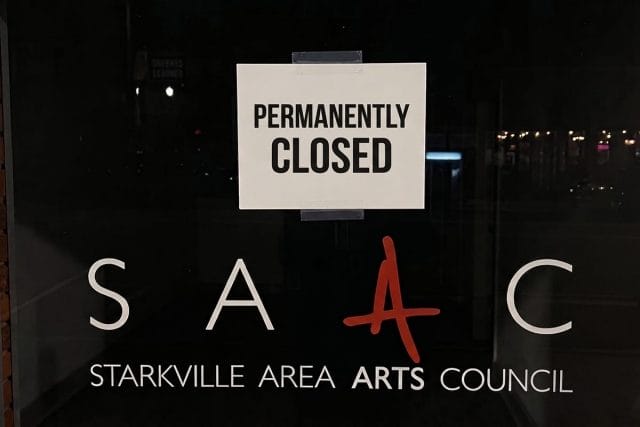
In 2020, Starkville Area Arts Council drafted a strategic plan with a dream that, by 2025, it would build a “modest” endowment of $500,000 and secure 25 local donors giving $5,000 annually.
The dream never materialized, as the group’s bank account instead dwindled to nearly nothing. With no publicly provided explanation or cause, SAAC announced its permanent dissolution via a Facebook post on Aug. 5.
“I felt like I had stepped onto the Titanic right before it hit the iceberg,” said Squeak Humphreys, SAAC’s last executive director. “… At the time I started in September (of 2025), we had six board members, and we only had around $30,000 in the bank. When I left in February of this year, there were three board members and $5,000.”

According to previous executive directors and board members, “myriad” reasons turned SAAC’s dreams into a nightmare.
An ill-fated cookbook fundraiser “costing well over $100,000” and the lawsuit that followed, an expensive move to a downtown Starkville storefront and four directors in four years – with one “lasting only a month” – led the few remaining board members to believe closing “was the only remaining option.”
Phillip Carter, board president when SAAC dissolved, said the end “played out over roughly five years.”
Despite that, SAAC’s signature event, Cotton District Arts Festival, will go on under different leadership.
SAAC’s undoing
SAAC was founded in 1996 as a way to promote the arts in the community. For much of the organization’s existence, it was headquartered in a one-room office space in the Greater Starkville Development Partnership building.
However, in 2021, it traded the $600 monthly rent for a storefront on Main Street that cost six times that. After that was no longer financially sustainable, the group moved its headquarters in fall 2024 to a shared space with Proof Bakery.
By November, two months after taking the director’s job, Humphreys was ordered to work from home, leaving SAAC without a public-facing space for the final months of its waning existence.
“To be completely honest with you, there were so many signs,” Humphreys said. “Working from home, … I was losing programs left and right. I had received no education about our finances. They just dropped it on me.”
Leadership at SAAC was its own revolving door. Humphreys replaced Charla Laney, who had stayed in the job only a month. Juliette Reid was interim director for nine months before that, as she replaced Mary Switzer, who led the organization from December 2021 to September 2024. Prior to Switzer was John Bateman, SAAC’s first salaried executive director who was at the helm from 2016 to 2021.
Reid helped spearhead the move to Main Street, claiming the organization needed more space to expand its programming. A grant helped fund the relocation costs for a year, but SAAC struggled to keep up the rent payments after the grant expired.
“We were in this little 10-by-15-by-15 office, and we needed bigger space to do anything more,” she said. “If we would have stayed there, we maybe could have lasted longer. But the thing about it is, you can’t really expand your programs when you’re working out of a windowless office. That’s not how you continue. That’s not how you increase your service to the community.”
But even without staffing troubles, public support was already declining. The organization’s IRS filings show gifts, grants and donations totaling $153,658 in 2020. By 2024, those had fallen to $37,872.
Reid credited the dropoff in support to the public’s response to drag performers at CDAF in 2022, among other reasons.
By 2025, Humphreys said SAAC used a Windgate Foundation grant meant for the Art Partners Program to instead pay her salary. In doing so, SAAC let go of the teachers for that program, Bonnie Renfroe and Joseph MacGown, who had actually written the grant.
Carter told The Dispatch the organization’s dissolution process included “repaying a major grantor in full,” but he did not confirm which grant.
Aside from a “severe lack of funding,” Humphreys said SAAC’s final months were “haunted by cookbooks and lawsuits.”
Cookbooks and lawsuits
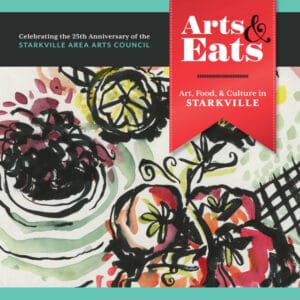
While trying to cope with the whiplashing cost of their new space, Reid and Switzer were also tasked with selling thousands of “Arts & Eats” cookbooks – a fundraiser cookbook with a collection of recipes, stories and artworks all contributed by local residents and supporters.
In 2021, in what Carter called a decision “rooted in good intentions,” SAAC had ordered 10,000 copies at a cost of nearly $130,000.
At $35 a book, SAAC hoped to generate about $220,000 in net proceeds. The group only ever got about 2,600 copies to sell. By 2025, SAAC was advertising the books on Facebook for $15, “buy one, get one,” while Humphreys said about 1,000 copies still sit in boxes in a storage unit.
“When the books actually came out, the support wasn’t really there,” Reid said. “I worked my butt off to try and sell those books. Nobody really wanted to buy the book.”
Reid said she felt in the beginning that there weren’t any “red flags” regarding the quantity SAAC ordered.
“Everyone was like, ‘Yeah, for sure. It sounds amazing,’” she said. “Nobody was blindsided by the fact that it was occurring. We took pre-orders. We told the public. We got support (for the order).”
Bateman, who decided along with the board to place the order, said it was based on the success of a similar cookbook in Oxford.
“We used the same publisher and the same model that the Yoknapatawpha Arts Council had done with the ‘Square Table Cookbook.’ … They sold thousands of copies,” he said. “The publisher offered a lot of free help to sell it because they had advised us on the book. … I don’t think it went the way any of us hoped it would.”
Bateman said SAAC agreed to a payment plan with Nashville-based Southwest Publishing Group, but Carter said the group only made enough payments to receive the 2,600 copies. The publishing group destroyed the rest of the inventory, Carter said, and sued SAAC for breach of contract in October 2025.
That suit was settled in February, but case records from Davidson County Circuit Court do not specify the terms.
“We could not have known that that would be a terrible decision,” Reid said. “We maybe could have ordered less books, probably, but it’s one of those things where hindsight is 20/20.”
Did the city offer any help?
In February, Carter and Humphreys met with Mike Tagert and Paige Hunt, director and tourism director, respectively, for the GSDP, as well as Mayor Lynn Spruill.
Spruill said they wanted an update about the arts council due to the “constant turnover” in executive directors, since the city, Oktibbeha County and GSDP all provided funding for the organization annually. That’s when she learned SAAC leaders did not foresee a path forward.
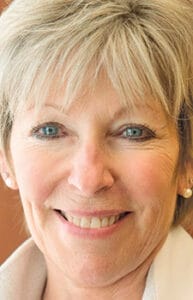
“I didn’t see any point in the city continuing to fund something that was not in a functioning capacity,” Spruill said. “We halted our next payment to them, because for all intents and purposes, there wasn’t anything to fund because they weren’t doing anything.”
After that meeting, Carter said he took on the “hard and unenviable work of wrapping up a beloved organization” when Humphreys resigned two weeks later.
Quan Walker, executive director of the Columbus Arts Council, said she was surprised by SAAC’s dissolution and hoped the two communities would collaborate. She also empathized with how difficult it can be to find critical funding.

“You always have to keep the wheels turning, and I think one of the most important things is being open-minded and willing to explore different opportunities,” she said.
So, who is taking responsibility for CDAF?
Despite SAAC’s dissolution, Libbi Havelin, head of the 2026 CDAF Committee, confirmed plans for next year’s festival are moving forward, with the date set for April 17, 2027.
She said that it won’t “be easy,” but the committee is prepared for the hustle that comes with putting on a festival of this size.
“We have our standing committee that will continue to work diligently to host our festival,” Havelin said. “We are very excited to move forward with planning this amazing event.”
SAAC’s 2022 IRS filings show the festival cost the nonprofit $41,083 to organize. On that same form it reported that the festival brought in $38,814 – leaving the festival $2,269 in the red.
Carter confirmed SAAC shuttered with “no remaining (CDAF) funds to transfer,” and that “the new organizing entity will build the festival’s funding independently going forward.”
This shouldn’t be a problem, Havelin said.
“It is an expensive event, but one that actually pays for itself,” she said. “Now that we are deciding how we want to proceed, we are exploring options of being our own entity or going under the umbrella of another organization.”
What now?
Carter said “most of SAAC’s programs, scholarships and grants concluded along with the dissolution,” though he said Starkville Public Library – where he works as the director – would continue to host the Arts Education program.
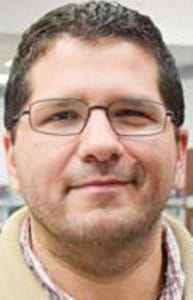
“SAAC gave this community 30 years and that legacy doesn’t disappear because the organization did,” Carter said. “If anything, I hope this makes room for whatever comes next … Starkville has never lacked artists or people who care about them. … That’s the part I hope people take away from this.”
You can help your community
Quality, in-depth journalism is essential to a healthy community. The Dispatch brings you the most complete reporting and insightful commentary in the Golden Triangle, but we need your help to continue our efforts. In the past week, our reporters have posted 42 articles to cdispatch.com. Please consider subscribing to our website for only $2.30 per week to help support local journalism and our community.