
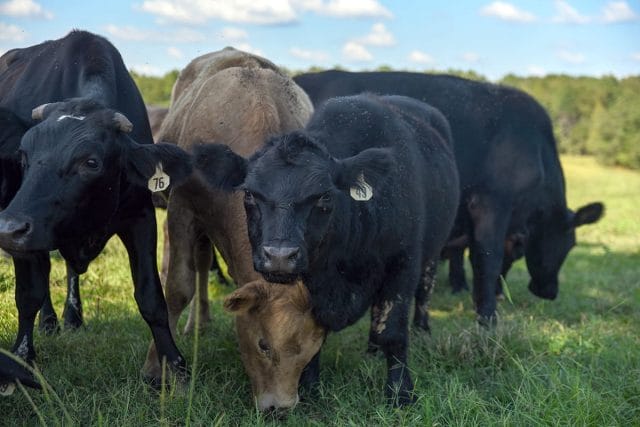
Golden Triangle cattle producers aren’t quite sounding the alarm over the Trump Administration’s decision to increase foreign beef imports. But they are watching the markets and wondering what the move might mean for the future of an already shrinking cattle herd.
That herd, according to data released in January by the United States Department of Agriculture, totaled 86.2 million head last year – the lowest inventory since 1951.
Still, John Elliott, who has farmed cattle in Clay County for more than 50 years and serves as the Area 4 vice president for the Mississippi Cattlemen’s Association, does not expect the federal decision to majorly impact the cattle market.
“I don’t feel like it’s going to wreck the market,” he said. “It’s going to be little blips on a radar screen.”
President Donald Trump on Friday announced plans on social media for the United States to import 300,000 metric tons of beef with lower tariffs in an effort to lower prices for consumers.
“We have a commitment that this beef will be sold at 25 percent below current market prices,” Trump wrote in the post to Truth Social. “This deal will reduce prices for Americans while giving space for our Great American Beef Herd to grow again.”
Brandi Bourg Karisch, who operates MBK Cattle in Starkville with her family, isn’t so sure the policy will aid in building the herd. Cattle producers are already facing high input costs.
“I mean, diesel is expensive,” she said. “… So filling trucks and tractors and those types of equipment is expensive. Fertilizer is expensive. Everything’s expensive. So it’s not something that’s encouraging us to want to have the capacity to be able to grow.”
Karisch, who is also a beef cattle specialist for Mississippi State University Extension Service, expects the biggest immediate impact on producers lies in the market volatility sparked by the announcement.
“We’ve seen, since the announcement was made last Friday, the local markets have dropped a little bit this week,” she said. “… Whenever there is uncertainty, like any type of market on any commodity, they react. Prices fluctuate on political announcements, essentially. So that’s what we saw here locally in the state, and prices were lower than what they were for the same cattle.”
At Cattlemens Stockyard in West Point, feeder steers sold for $10 to $20 lower per hundredweight than last week while feeder heifers averaged between $15 to $20 lower per hundredweight, according to the Mississippi Department of Agriculture’s market news report for Aug. 24 – a drop of 3-7%.
Still, Elliott feels the recent decline is more of a short-term reaction than a sign of a collapsing market.
“They’re down some, but (cattle sold over the weekend) still brought a darn, darn good price than we’ve been getting most of our lives,” he said. “So we’re not complaining.”
Price pressure
While he acknowledged pressure on consumers from high beef prices, Marcus Swentkofske, co-owner of Shady Acres Farm in West Point, took issue with the federal decision. Lowering beef prices at “the expense of the … American cattle farmer,” he said is not the way to do it.
“We share the concerns with the consumer because prices have gone up for producers as well, but the way to address that is to invest more in the American Cattle herd, make sure that we can grow and invest in our cow-calf producers,” he said. “If we can (do that) and produce more cattle domestically, that’ll certainly lead to a better outcome for everyone in the United States.”
Shady Acres is a grass-fed beef operation that sells directly to customers, as opposed to commercial operations, which sell into the broader cattle market. While the federal decision has sparked more interest in the farm’s domestic product, Swentkofske worries cheaper imported beef could eventually make it harder for his operation to compete.
“I’ve gotten a lot of people who have specifically said they’re seeking me out because I’m an American cattle farmer,” Swentkofske said. “… They’re telling me that the meat they’re getting at Kroger or other similar large box stores just isn’t quite the same. So I’m happy to be providing what I can, but if we’re going to import cheap beef from somewhere else, it could price me out and make it difficult for me to do what I’m doing.”
In Caledonia, Mitch Bulley, owner of butcher shop Bulley’s Lodge, said he’s fielded a few concerns from customers since the announcement was made.
Likewise, Bulley has been meeting with staff to ensure they’re ready to reassure customers that the shop will continue purchasing only USDA-inspected beef.
“I think it’s a bad thing for our local and national American beef farmers,” he said. “But at the same time, I do think … it could turn into a good thing for small, specialty shops like us who people know they can trust to carry that American beef (and) … be very transparent with where everything comes from.”
Those customer relationships could be strengthened through this, Bulley said, but the potential benefit doesn’t erase pressures consumers are facing from high prices.
“But at the same time, I do understand where people are coming from,” he said. “Me and you are not immune to the effects that these high grocery prices have, and when there’s no real end in sight, I get why budget conscious people would want some sort of relief. Whether this is the right way to do it or not is yet to be seen.”
McRae is a general assignment and education reporter for The Dispatch.
You can help your community
Quality, in-depth journalism is essential to a healthy community. The Dispatch brings you the most complete reporting and insightful commentary in the Golden Triangle, but we need your help to continue our efforts. In the past week, our reporters have posted 42 articles to cdispatch.com. Please consider subscribing to our website for only $2.30 per week to help support local journalism and our community.