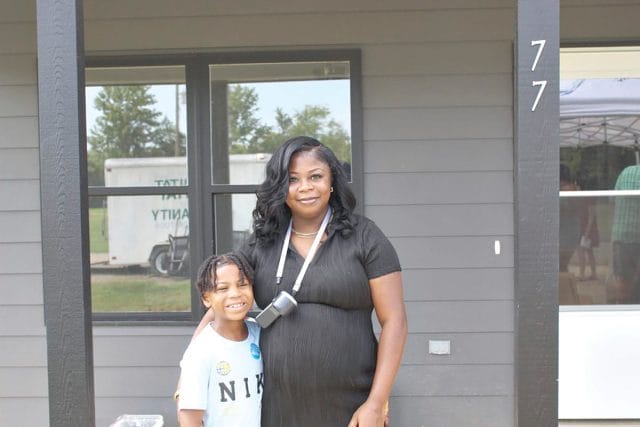
Last spring, Chiquita Brown had not even heard of Habitat for Humanity. But now she’s counting down the days to her September move-in thanks to Starkville Habitat for Humanity.
Brown found out about the group close to the application deadline for its Partnership Program, which provides a pathway for low-cost homeownership for people who would otherwise be unable to own a house.
Brown at the time was renting an apartment and rushed to submit her application, handing it in on the day of the deadline.
She was interviewed by the Family Selection Committee, and construction began on her home a few months later.
“It had to be God,” Brown told The Dispatch on Friday, following a dedication ceremony for her home on Dudley Lane in east of Starkville. “… I’ve been standing tall for seven years with my baby in my apartment and someone told me about Habitat, gave me an application… I can’t believe it. I was shocked (when I was approved quickly).”
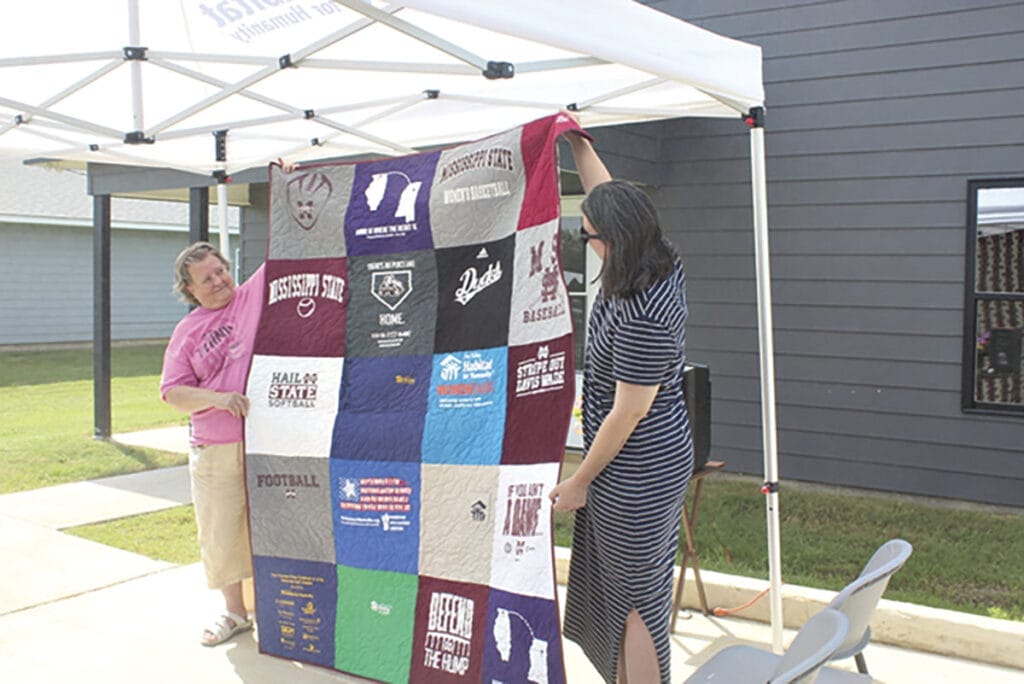
While Brown was approved quickly, the application process is rather intensive and often leaves Starkville Habitat struggling to find qualified applicants, the organization’s public relations coordinator Charla Laney told The Dispatch.
“We don’t want anyone to be out there without a paddle, not to be able to handle the financial responsibility of a house,” Laney said. “So, really, it is because you have to grab a sweet spot.”
A partner needs to have good credit, earn an income between 60% and 80% of the Department of Housing and Development’s guidelines, which for a family of four in Oktibbeha is between $49,080 and $65,440. The applicant must also earn enough that their mortgage will not be more than 33% of their income.
Once an applicant meets those thresholds, Starkville Habitat also vets whether they will make a good partner and contribute the required “sweat equity” – 300 hours of labor building their own house or a neighbor’s.
Laney estimated the group can usually find a partner within one to two months of closing applications, allowing it to build about two houses a year.
On the other hand, Columbus Habitat for Humanity only builds one house annually. But in recent years, it has found it increasingly difficult to find qualified applicants, Executive Director Kathy Arinder told The Dispatch. In the last application cycle, it took the group about five months and 50 applications to find one qualified partner, she said.
Columbus Habitat has a similarly stringent application process requiring applicants to demonstrate need, ability to pay a mortgage, willingness to partner and a good credit score, Arinder told The Dispatch.
Arinder said the group’s requirements have gotten stricter in the last few years after it decided to finance homes through the United States Department of Agriculture instead of providing mortgages itself. The Starkville branch still finances homes itself.
“By allowing USDA or a third-party mortgagee to hold the loan that frees up the money for us to be able to build the home without having to raise funds,” Arinder told The Dispatch.
Arinder said finding qualified candidates is not the only issue facing Columbus Habitat after its volunteer staff was “decimated” during the COVID-19 pandemic.
The rising cost of liability insurance has also caused the group to limit volunteer support to lighter tasks like painting and landscaping and rely on contractors for all heavy construction, she said.
The Starkville branch keeps a healthier network of volunteers, Laney said, with school groups and Mississippi State University students often present on sites and contractors taking on only more technical construction tasks like plumbing and electrical.
MSU partners with the group for a Maroon Edition home each year, which it provides volunteers and some funding for, Laney said. Brown’s house is the 17th built as part of this partnership and the 78th house Starkville Habitat has built since its founding in 1986.
Brown’s new home is also part of a new community Starkville Habitat is creating in Kelly Estates, a former 11-acre dairy farm on 16th Section Road where the organization is planning to build about 30 houses. Brown’s home is the sixth built in the neighborhood.
After the eighth home is complete, the group will need to finish phase two of the project – which includes paving roads, adding a cul-de-sac and expanding plumbing and electrical services – before it will be ready to expand.
“I’m not sure when we’re going to be able to open up our applications again,” Laney said. “We were hoping maybe this year but we are still not exactly sure. We have to make sure that we have the funding that we need for phase two … and then I think we’ll be able to accept applications again.”
The group will break ground on its eighth home in the old Kelly Estate and third build of this year on Tuesday.
Columbus Habitat hopes to break ground on its one build of the year in the next few months, which will be the 58th or 59th home it has built since its founding in 1989, Arinder told The Dispatch.
You can help your community
Quality, in-depth journalism is essential to a healthy community. The Dispatch brings you the most complete reporting and insightful commentary in the Golden Triangle, but we need your help to continue our efforts. In the past week, our reporters have posted 37 articles to cdispatch.com. Please consider subscribing to our website for only $2.30 per week to help support local journalism and our community.