STARKVILLE – Starting next week, Bryan Farrell, director of Mississippi State University’s Raspet Flight Laboratory, said a multi-state research project is looking to improve air taxi services to where travelers are no longer tied to using commercial airlines.
The goal is to eventually automate an air taxi’s takeoff, flight and landing without a pilot on board, Farrell said.
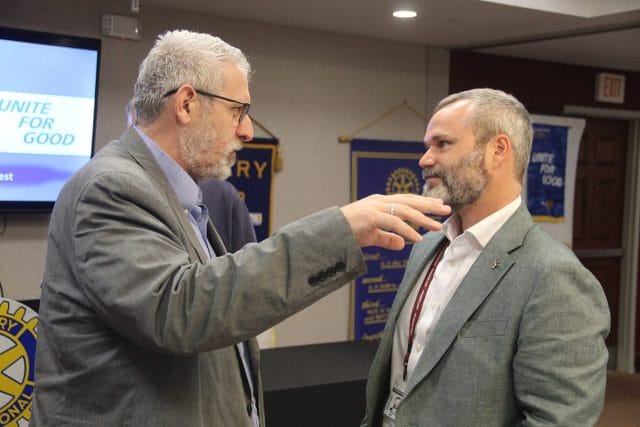
“If everybody remembers ‘The Jetsons,’ this is Jetsons phase one,” Farrell said to Rotarians during Monday’s meeting at Hilton Garden Inn.
Raspet, as part of a bid to the Federal Aviation Administration selected in March representing Mississippi, Louisiana and Texas, was approved to assist a project to test and improve cargo and personnel transportation capabilities for unmanned aircraft. The goal is to improve flights over high seas into the Gulf of Mexico and to better supply oil rigs off the coast, Farrell said.
“(The research is looking at) effectively a way to more cheaply move people around within a regional platform, so that you don’t have to rely on commercial aircraft, which tend to be expensive,” Farrell said. “(Uncrewed aircraft) are fairly cheap and they’re electric, and so this is going to be a major breakthrough for regional mobility and logistics and things like in the oil and gas industry, trying to get things out to the rigs, trying to get new equipment out there, trying to do post-disaster response analysis, trying to move people in and out where traditionally they’ve used helicopters.”
Farrell told The Dispatch the research, which will largely happen along the Mississippi Gulf Coast, is expected to take at least five years.
Farrell said the program serves as an example of how the FAA has recently pushed for faster and more innovative solutions related to flight.
“The last couple of years, you could tell that they’ve postured to move quicker,” Farrell said. “I don’t think the FAA always had the best reputation for being agile when it came to rulemaking or integration. But what I’ve seen recently with their emphasis on advanced air mobility, the pushing for more waivers (and) more processes to get those things out. They’re posturing to move faster to catch up to where the technology is.”
Recent projects
Farrell spoke with Rotarians about other major projects Raspet has seen significant progress in over the last year.
The Defense Advanced Research Projects Agency Albatross program, which is being spearheaded by different MSU departments, began in May 2025 and aims to develop algorithms in smaller unmanned fixed-wing planes to use weather conditions like wind and turbulence to fly while using less energy.
Farrell said researchers have already performed several test flights that have shown a near 75% reduction in energy use for the fixed-wing aircraft.
While the project still has another year of testing in several other kinds of weather conditions, Farrell said the results so far have been inspiring.
Once complete, Farrell said the Albatross system could also have applications and provide a framework to improve energy use for other aircraft too.
“You’ll have to do some tuning for other aircraft, for … the way they perform, but the algorithm and the type of knowledge that we’re developing should be platform-agnostic,” Farrell said. “It shouldn’t take too much to put it into a different system.”
Farrell told The Dispatch that Raspet’s research efforts on testing Aurora Flight Sciences’ SKIRON-X, an unmanned aircraft system, which also began in May 2025, largely concluded in December and resulted in a publicly available guide for first responders to apply for drone flight use beyond visual line of sight.
Flying beyond an operator’s visual line of sight typically requires them to meet higher safety thresholds and have a waiver from the FAA.
The guide, also called a safety case, was developed to help give a roadmap for agencies’ applications and help them navigate receiving FAA approval to use a drone for emergency responses.
With that draft, Farrell said it opens the door for agencies like Starkville Police Department or other emergency responders to receive permission from the FAA to use a drone to determine damage from severe weather, the severity of a wreck, and emergency situations broadly prior to arriving on scene.
“Being able to get out and look at a large area, search a large area, diagnose issues on a large area, or whatever the case may be, is huge,” Farrell told The Dispatch. “… Game day traffic, you’ve got a backup they can go and tell you what the problem is. … If there’s an emergency situation, they can respond quickly. They can give you eyes in the sky and situational awareness, so that’s very valuable.”
You can help your community
Quality, in-depth journalism is essential to a healthy community. The Dispatch brings you the most complete reporting and insightful commentary in the Golden Triangle, but we need your help to continue our efforts. In the past week, our reporters have posted 37 articles to cdispatch.com. Please consider subscribing to our website for only $2.30 per week to help support local journalism and our community.