Emily McLarty, since moving to Columbus in 2023, has seen several houses in her neighborhood on 11th Avenue North deteriorate into eyesores.
Those homes, she said, have overgrown yards, broken windows and squatters that are draining the value of other homes in the neighborhood, including hers.
“We’ve had to call consistently about it,” McLarty told The Dispatch after the town hall. “There’s constantly squatters. When I say the weeds are (between 8 to 9 feet tall), it’s about to become reforested. We have another blighted property right down the street from us (and) it also has squatters at the corner of Military (Road) and 11th Avenue. So we have two right there. It’s making our property values fall. Safety is an issue. People can’t sell their houses because these houses are there. So they can’t move out. They can’t get any money for their houses, and so it’s really a huge issue.”
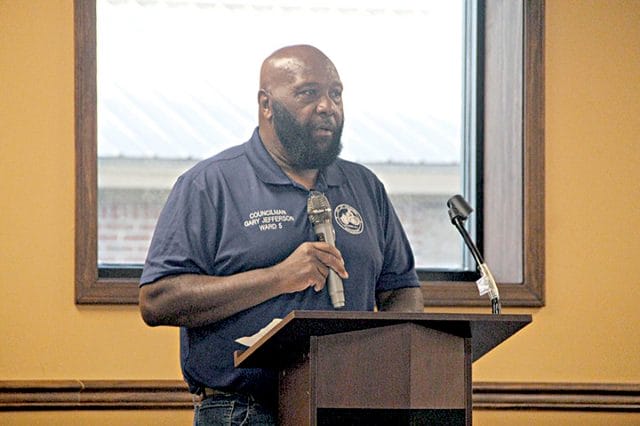
McLarty wanted to know what the city is doing or planning to remedy those issues, which is why she and other Ward 5 residents gathered Monday for a town hall at the Sim Scott Community Center.
Gary Jefferson, councilman for Ward 5 who organized the town hall, told residents the city is taking those issues seriously and addressing them through its recently improved code enforcement methods and the city’s blight program.
“I know it can look bleak at times, but every day we are working or thinking about something that can help this community,” Jefferson said. “… It’s a struggle for us, and I know we’re all tired of looking at it. I’m tired of going to different places and seeing what I see. But every day we have to, the community has to work together to come up with solutions.”
Citation process
Nathan Katona, building department director, told The Dispatch there are currently two methods for addressing a building out of code.
The property owner could be issued a municipal court ticket for issues like broken windows, peeling paint and holes on the exterior of the house. The fine for each infraction is up to $1,000.
If left unfixed after a court hearing, those fines could grow by $1,000 for every additional day the problem remains, Katona said.
Katona said this process was revived about eight months ago when code enforcement and building inspection were merged under one roof.
“We fired that back up (but) it’s been on the books,” Katona said. “It’s not something we created. It’s been there for a long time. … It wasn’t used.”
Though it’s only been about eight months, Katona said the process has already helped to push homeowners in the right direction for addressing exterior issues with their homes. That is, for the homeowners his department can find.
If a property owner cannot be located or is deceased and a building is in a severe state of dilapidation and deemed a public nuisance, it is brought to the council for consideration to begin abatement and demolish it, Katona said.
To demolish a home, it typically costs the city between $5,000 and $7,000, Katona said. Those costs balloon by several thousand more if the building has wide-scale issues of asbestos.
Katona said in the last eight months, there have been about four properties in the city demolished, and there are about 12 more in a backlog for future demolition.
For homes with large-scale issues of dilapidation or that reach the point of needing to be destroyed, Katona said abatement is typically the best process, but the city looks to its federally funded blight program to remedy some of those issues.
“If we can’t get a hold of anybody, abatement is the only (option) left,” Katona said. “That’s one of the things that the blight program answers. That way the city isn’t having to spend money and put these liens on a piece of property that’s never going to be paid. It’s basically the city is just spending that money, which we do not think that’s a good use of taxpayer dollars if there’s another option.”
Blight program
George Irby, interim planning and community development director, said the blight program is “not where (he wants) it to be,” but is well on its way to gaining traction.
The program, which launched in 2022 to address deteriorating properties in the city, is funded by $6 million from the U.S. Department of Housing and Urban Development and $100,000 from the American Rescue Plan Act.
The program really got moving earlier this year, Irby said, when it saw its first property demolished in January.
Since then, the program has purchased roughly 22 of the 350 properties identified by the city. Irby said 14 of those properties were sold for roughly $13,000 to the city from the state of Mississippi after they took them over due to tax forfeiture.
The city purchased the other eight properties for roughly $83,000 combined.
Of those 22 properties, Irby said three have been demolished and one has already sold for $2,000 to a developer. Those other two have been advertised for sale.
Irby said part of the issues that have existed in making progress on these blighted properties are obtaining title opinions and locating the heir of a property.
Irby said conversations with HUD officials have also slowed the purchase of some properties with liens, because of confusion on whether the city can make those purchases.
“There is a federal statute that prohibits using federal funds where the benefactor is owed, like if the city has a lien on some property, you can’t use the blight money to pay off those liens,” Irby said. “And there’s some questions because we did put in our policy that we wanted to be able to buy all liens, and that is being discussed now to see if we will be able to do that.”
You can help your community
Quality, in-depth journalism is essential to a healthy community. The Dispatch brings you the most complete reporting and insightful commentary in the Golden Triangle, but we need your help to continue our efforts. In the past week, our reporters have posted 40 articles to cdispatch.com. Please consider subscribing to our website for only $2.30 per week to help support local journalism and our community.