






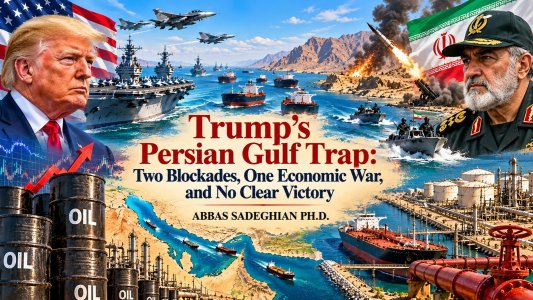
Trump's Persian Gulf Trap: Two Blockades, One Economic War, and No Clear Victory
By Abbas Sadeghian, Ph.D.
A War in Which Both Sides Are Blockading—and Both Are Bleeding
The Persian Gulf has become the center of an extraordinary contradiction in modern warfare. The United States is attempting to strangle Iran's economy by restricting its petroleum exports, while Tehran is attempting to retaliate by obstructing maritime traffic through the Strait of Hormuz. Both governments possess substantial capabilities to damage international commerce, and both claim to be exercising considerable control over the movement of oil. Yet commercial vessels continue to sail, Iranian petroleum products reportedly reach foreign markets, and international energy companies are finding ways to operate around the restrictions. The confrontation raises an important question: If both sides can blockade one another, why has neither been able to achieve a decisive political result?
The answer lies in the fundamental difference between military superiority and economic control. A blockade does not have to be completely airtight to inflict enormous damage, but neither naval power nor geographical advantage guarantees control over an interconnected global economy. Petroleum markets consist of overlapping networks of producers, refineries, pipelines, shipping companies, insurers, financial institutions, and consumers. Disrupting one part of that system produces consequences throughout the network, including consequences for the government imposing the restrictions. Washington wants to deprive Tehran of petroleum revenue without driving international energy prices to politically unacceptable levels. Iran wants to impose economic costs on its adversaries without destroying its own ability to conduct international trade. Both governments are pursuing strategies that contain serious internal contradictions.
The conflict has therefore evolved into a contest of economic endurance rather than a straightforward demonstration of military power. The United States possesses overwhelming conventional superiority, but Iran retains geographical advantages and asymmetric military capabilities that allow it to threaten commercial shipping. Neither advantage automatically translates into a favorable political settlement. The central paradox of the confrontation is that both governments can impose substantial economic damage, yet neither can fully control the consequences of its own actions.
The Strait of Hormuz: Geography as an Instrument of Economic Warfare
The Strait of Hormuz connects the Persian Gulf to the Gulf of Oman and the Indian Ocean. At its narrowest point, the strait measures approximately 21 miles across, but its strategic importance is vastly greater than its geographical dimensions suggest. It serves as a critical maritime passage for petroleum exports from Saudi Arabia, Iraq, Kuwait, the United Arab Emirates, Qatar, and Iran. The international economy depends heavily on the uninterrupted movement of energy through this narrow corridor.
According to the U.S. Energy Information Administration, approximately 20.9 million barrels of crude oil, condensate, and petroleum products passed through Hormuz daily during the first half of 2025. That represented approximately one-fifth of global petroleum liquids consumption and roughly one-quarter of maritime petroleum trade. More than one-fifth of international liquefied natural gas trade also passed through the strait, primarily from Qatar. These figures explain why even a partial disruption can influence petroleum prices, transportation costs, industrial production, and inflation across the world.
Iran has understood the strategic significance of this geography for decades. During the Iran-Iraq War, attacks on commercial shipping transformed the Persian Gulf into an international security crisis. The Tanker War demonstrated that relatively limited military operations could threaten a much larger commercial system. American naval intervention eventually produced direct military confrontation with Iran, including Operation Praying Mantis in April 1988. Although the present conflict differs substantially in technology and political circumstances, the underlying strategic principle remains recognizable: Iran does not need to defeat the American Navy in a conventional battle to impose serious economic costs. It needs only to make maritime transportation sufficiently dangerous, unpredictable, and expensive.
The American Blockade: Economic Success Without Complete Control
Washington's blockade operates through naval interdiction, financial sanctions, intelligence gathering, and pressure on international shipping networks. Its principal economic objective is to restrict Iran's petroleum revenue, thereby reducing the resources available to the Iranian government and its military institutions. The available reporting indicates that these restrictions have significantly affected Iranian crude exports. Shipping intelligence cited by Reuters reported that Iranian crude oil exports fell to zero in September, the first such monthly reading in Kpler's tracking records extending back to 2013. Although these estimates cannot establish that every possible shipment was prevented, they indicate a severe disruption of Iran's principal source of export earnings.
The situation becomes more complicated when refined petroleum products and liquefied petroleum gas are examined. An October 16 Reuters investigation reported that at least eight tankers carrying Iranian liquefied petroleum gas had managed to leave the Gulf of Oman since mid-July. Another vessel carrying Iranian jet fuel reportedly reached Myanmar in September. Some shipments involved ship-to-ship transfers near the Omani coast, while others moved toward Malaysian waters, with China identified as a possible ultimate destination. These movements demonstrate that the blockade has not eliminated every channel of Iranian petroleum commerce.
The distinction between crude oil and petroleum products is essential. Preventing the export of large volumes of crude oil is operationally different from identifying and intercepting smaller vessels carrying refined products or liquefied petroleum gas. Tankers can change flags, ownership arrangements, destinations, and identification practices. Cargoes can be transferred between vessels, making their origins increasingly difficult to establish. Modern maritime surveillance relies on satellite imagery, automatic identification systems, shipping records, and intelligence gathered from ports and financial institutions, but these methods cannot eliminate deception or guarantee the detection of every transaction.
Consequently, the American blockade can be economically effective without being militarily absolute. Tehran may lose most of its crude export revenue while retaining limited channels for petroleum products and other commercial activity. Those remaining channels can provide valuable foreign exchange and support essential economic operations, but they cannot necessarily compensate for the loss of large-scale crude exports. The persistence of some Iranian shipping therefore illustrates the limits of maritime enforcement rather than proving that the blockade is ineffective.
Next Page 1 | 2 | 3 | 4 | 5 | 6
(Note: You can view every article as one long page if you sign up as an Advocate Member, or higher).






 Post Article Comment and Rate This Article








