Asia: KOSPI (+1.37%), Nikkei (+0.69%), Hang Seng (+.19%)
Spot gold: -0.25% to $US4,272/ounce
Oil (Brent): -2.8% to $US105.83/barrel
Iron ore: +0.32% at $US97/tonne
Bitcoin: +0.13% to $US76,223
Prices current at around 10:15am AEST
Choose what information you see below by using filters
Filter Posts
Donald Trump's Truth Social posts are frequently unnerving.
This one, in response to the Federal Reserve's interest rate rise overnight, demonstrates a fundamental lack of economic understanding.
"We are the Best Credit in the World — BY FAR. Our Country is BOOMING with new Investment!," he posted on social media.
"LOWER THE INTEREST RATES FOR THE UNITED STATES OF AMERICA, AND FAST!."
If a country is booming with new investment, much of which is coming from borrowed money, and its inflation rate is well above the central bank's target, then that's exactly when interest rates should go up, not down.
Perhaps it's no surprise then that the 12 monetary policy experts on the Federal Open Market Committee (FOMC) were unanimous in their decision to raise US rates.
They clearly agree with (most) of the president's economic assessment in the first sentence, but they (and the weight of pretty much whichever economic theory you subscribe to) strongly disagree with his proposed course of action in the second.
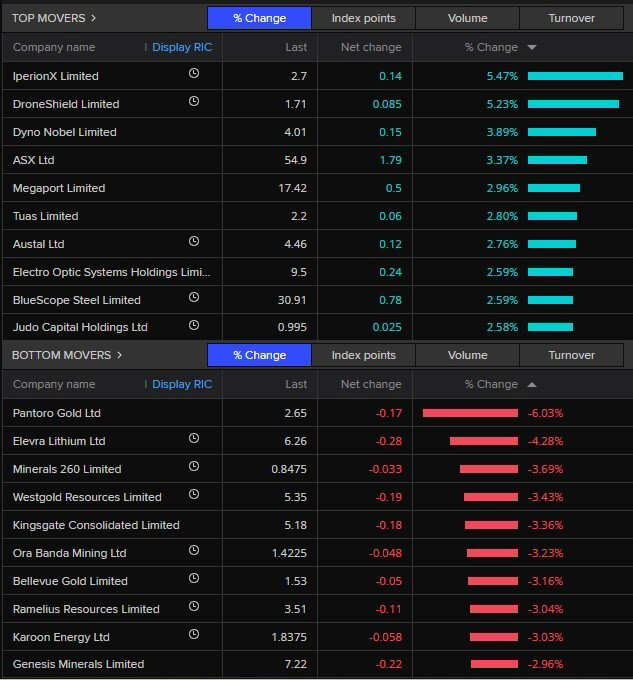
Droneshield and Judo Capital are among the standout names in this morning's top movers.
But it's US-based titanium alloy company IperionX that's doing the best after validating its continuous titanium production platform, which is said to be six times faster at producing titanium and uses less electricity.
Top and bottom movers for Thursday morning (LSEG)
The ASX 200 is now up more than half a percent during this morning's trade.
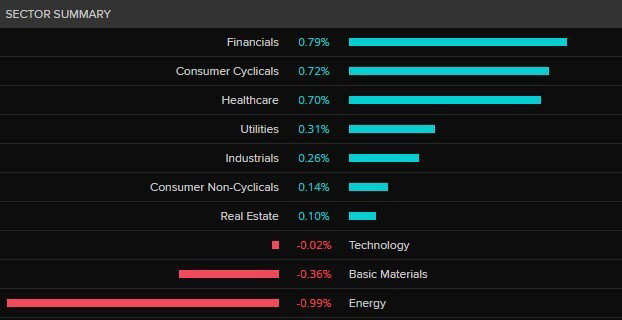
Here's a look at what's doing well, and, not-so-well.
Sector Summar ASX 200 (LSEG)
There's a rush on as commuting consumers follow the price signals and shift into electric vehicles (EVs) at a furious rate.
Despite the long and obvious technological advantages the cars would go on to have, their take-up has been limited by the high sticker price and a lack of charging infrastructure.
As the petrol price has rocketed - and the number of people with home batteries to complement their solar panels - has soared, so too has the proportion of EVs as new car sales.
But there's a bigger problem.
And that problem is around big-ness.
While you'll see electric buses and some trucks, the technology is less evolved and the sunk - already spent - cost is higher.
So while it's happening, and will keep doing so, there's been less of a rapid switch in fields of transportation that are heavier.
Ships, trucks, machinery, heavy-haulers, trains, planes... all the moving-around-of-stuff architecture we have (in a large country with a small population) is powered by diesel.
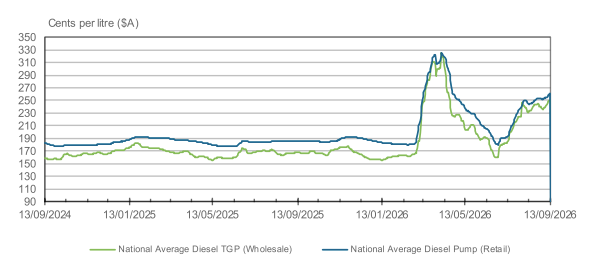
And here's what's happened to the price in the past two years.
Diesel prices over the past two years (Australian Institute of Petroluem)
As discussed in an earlier post, there are multiple factors pushing up the cost of diesel.
And that means, pushing up the cost of practically everything.
Comparison site Canstar says NAB and ANZ have today hiked fixed rates by up to 0.20 percentage points, 12 days out from the September RBA cash rate decision.
After weeks of inactivity, fixed rates have now started to move, and they’re on the way up, not down.
ING yesterday hiked its fixed rates by 0.20 percentage points, taking its lowest fixed rate to 6.39%, while Macquarie hiked last week. Its lowest fixed rate is also now 6.39%.
This takes the number of lenders hiking fixed rates in the month of September to nine.
"While this is now a noteworthy shift in the lead-up to the next RBA meeting, the number of lenders hiking fixed rates is still relatively low compared to previous months where the possibility of a cash rate rise was on the table," it says.
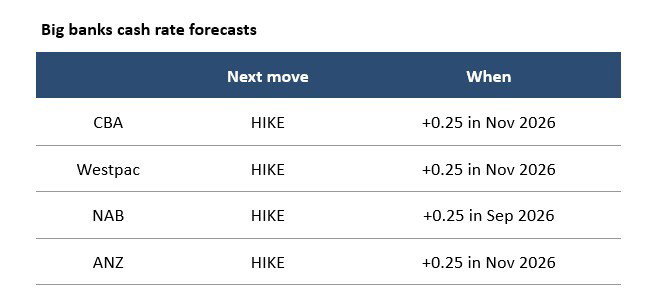
All four big bank economic teams are forecasting the next cash rate move will be a hike, however, the timing is contested.
CBA, Westpac and ANZ all predict the RBA will hike in November, while NAB expects the first hike to come in 12 days’ time on 29 September.
Here's a table of their tips:
Interest Rate predictions (Canstar)
I've been deep in diesel - talking to farmers in inland NSW and people in container yards in Melbourne - and tomorrow with my colleague Jasper Wells we'll have a solid look at the current situation and where it's heading.
The short version is that we have a supply problem (with the conflict spreading to the Red Sea shipping routes) a refinery problem (with capacity reduced by the conflict and by elements like the fire at Viva Energy's plant in Corio) and that's leading to a cost problem.
Let's look at it.
Crude oil is refined into liquid fuel products like petrol, diesel and airline fuel.
The 'crack spread' notes the gap between the cost of crude oil the final cost of the and refined products.
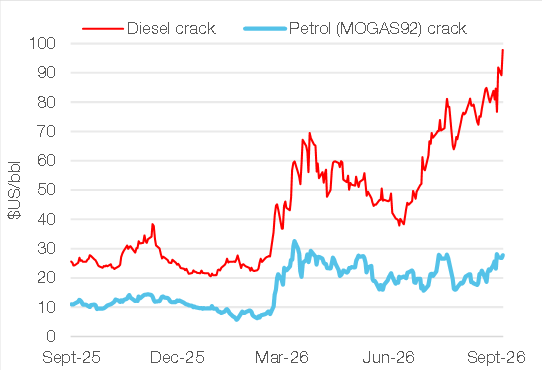
Check this out.
We know what crude oil costs - this is what the cost is once you refine it (ICE, Bloomberg)
You'll see that the cost of diesel used to be about $US20-30 above the cost (per barrel) of crude oil.
Now, it's about $US100 more.
Less refinery capacity, the same or more demand.
Financial markets are now pricing in an 88% chance the Reserve Bank of Australia (RBA) will raise its cash rate target in September, after the US Federal Reserve's Open Market Committee (FOMC) voted unanimously to raise interest rates overnight.
The Fed raised its target rate by 0.25 of a percentage point to 3.75-4%, and the market is now convinced the RBA will do the same, taking its cash rate to 4.6%, which would be its highest level since October 2011.
Betashares chief economist David Bassanese believes Australia's central bank cannot put off a rate hike beyond this month.
"The Fed's rate rise will likely add to pressure on the Reserve Bank to raise interest rates again," he argues.
"My base case has shifted, with the RBA now expected to raise rates at its policy meeting later this month, with a 50% chance of a follow up rate rise in November.
"Global inflation pressures, resulting both the Iran war and AI boom, along with domestic pressures, suggest the RBA can't afford to wait until November before raising rates again."
Markets are pricing about a 34% chance that the cash rate will get to 4.85% by November, and a roughly 50% chance it'll be at that level by the end of the year.
Mr Bassanese says this will likely result in tough times for big sectors of Australia's domestic economy, as the RBA seeks to offset inflation pressure arising elsewhere.
"Further rate rises will add to the downward pressure on house prices, which in turn risks of more substantial slowing in consumer spending and housing construction," he warns.
"Lower house prices will be seen by the RBA as part of the transmission mechanism whereby higher rates help slow economic growth and bring down inflation."
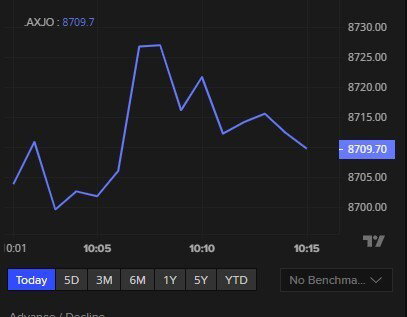
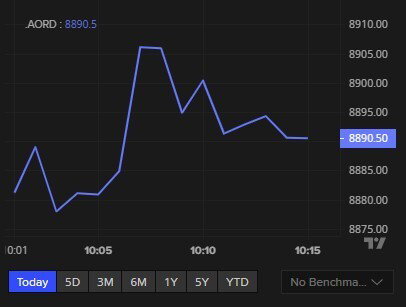
They're out of the blocks quickly this morning on the ASX, with the ASX 200 and All Ordinaries both up 0.23% after the US Federal Reserve decision to increase interest rates.
But things are a little bumpy so watch this space.
This is the ASX 200:
ASX 200 Thursday, Sept 17 (LSEG)
This is the All Ordinaries:
All Ordinaries Thursday, Sept 17 (LSEG)
With economic pressures mounting the National Debt Helpline has seen a 12 per cent spike in requests for help.
Here are some tips from our business reporter Adelaide Miller on how to deal with a debt notice or collector if they come your way.
We're starting to see local analysts react to the Fed rate rise and its implications for the Reserve Bank's next meeting on September 28-29.
Van Eck's head of investments and capital markets Russel Chesler believes that the RBA might need to raise rates multiple times, which is what markets are also pricing.
"The renewed surge in oil prices threatens to intensify inflation across the global economy, increasing the likelihood that both the Fed and the RBA will need to raise rates more than once," he writes.
"In our view, the RBA has no other option but to increase the cash rate by 25 bps [basis points] bringing it to 4.6%.
"The knock-on effects of higher oil prices flowing through to logistics, manufacturing and even food prices pose a significant risk of pushing the trimmed mean number higher, and a second rate increase may also be on the cards for the RBA still this year."
However, Chesler points out, as have many economists including at the Reserve Bank, that price pressures in Australia are not only being imported.
"Australia is still battling with services inflation which remains sticky," he argues.
"The minimum wage increase of 6% and the award wage increase of 4.75% may well filter into increases received by higher income earners during the year.
"Public sector wage growth for the year to 30 June 2026 was also relatively high at 3.4% ahead of the private sector at 3.1%.
"The GDP print of 0.4% for the second quarter and 2.1% annually suggests the economy is slowing but is still stronger than expected."
It's an interesting position taken by $42b fund manager Cathie Wood.
She reckons that the productivity generated by artificial intelligence will push prices lower.
Nonetheless, she reckons economic growth will be so strong that, despite the deflation, short-term interest rates will need to rise to between 6.5-7.5%.
She is mainly referring to US rates but, if anything, Australian interest rates tend to be a bit higher than American ones — we don't have the world's main reserve currency after all.
Wood spoke to The Business on her current visit to Australia and in this piece business editor Michael Janda takes a look at her views on AI.
For those new to the machinations of the US Federal Reserve, its committee members do what's called a dot plot at the end of the meeting.
The dot plot is a signal about what members of the committee think inflation will do - they each literally put a dot on a graph. They are read as closely as any economic tea leaves can be.
This time around was no different with new chair Kevin Warsh seeming to have continued his practice of refraining from plotting.
The dot plots from this meeting showed 16 of US Fed officials expect to hike rates this year while two see rates holding steady.
"The striking feature of the dot plot is the disappearance of the doves," analysts at Evercore ISI said.
"The old center dovish majority now lines up behind a limited hawkish mid-cycle adjustment — in their eyes at least likely for risk insurance purposes, though Warsh himself did not use the risk insurance language and preferred a more hawkish framing," they added.
-With Reuters
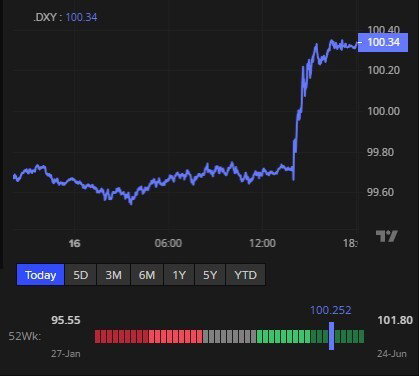
The US dollar moved higher on Wednesday after the announcement by US Federal Reserve to raise interest rates to 4.00%
An index known as the DXY, which measures the currency against other major currencies, saw the USD last at 100.34 — up by about 0.62%.
Against the AUD it was 70.86c, up a similar amount.
Compared to the Japanese Yen, which has had its own woes of late, it was 156.298 - down by 0.79%.
The DXY shot up on the Fed Reserve's announcement (LSEG)
Oxford Economics chief US economist Michael Pearce says the Fed's overnight decision to raise rates to 3.75-4% reflects a structural shift higher in the "neutral rate" — the theoretical level at which interest rates neither boost nor restrict economic activity.
"We expect the Federal Reserve to follow Wednesday's 25bp [basis point] rate hike with another in December before moving to the sidelines for an extended pause as inflation gradually moves lower," he writes in response to the FOMC decision.
"We've pushed back rate cuts in our forecast to 2028, from late 2027, and expect them to bottom out at a higher neutral rate of 3.25%-3.5%."
One line in Michael Pearce's note resonates with something I wrote earlier this week about the limitations of interest rates when used as the sole policy lever to lower inflation.
"Fed rate hikes won't stop inflationary pressures from higher gasoline and diesel prices and are unlikely to slow the AI buildout, which is putting upward pressure on prices," Pearce argues.
"But by slowing activity elsewhere in the economy, they'll contribute to a slowdown in broader price pressures."
I compared the current round of rate rises to the old medical practice of bloodletting, which lasted for millennia before people finally realised it did more harm than good in most circumstances. You can read that analysis piece below.
For those keeping a close watch on Brent Crude and WTI you can get a local snapshot of bowser prices through the ABC's fuel tracker.
Or maybe you just need to fill up on the way home - either way it's a useful tool!
Oil prices closed lower overnight after reaching their highest levels in nearly four months, following reports Saudi Arabia could reactivate a strategically important pipeline damaged by drone attacks earlier than expected.
Currently, Brent Crude is $105.6USD a barrel, down 2.9%, after closing the prior session at $108.75.
The decline occurred despite ongoing clashes between Yemen's Houthi rebels and the Saudi government.
The price of West Texas Intermediate (WTI) crude oil fell by 3.21% to $102.43.
On Wednesday, reports emerged that Saudi Arabia would manage to restore the flow of crude oil affected by the closure of the East-West pipeline earlier than expected, and that they had also offered additional shipments through Oman.
Robert Yawger, an analyst at Mizuho USA, told AFP:
"Recent events in Saudi Arabia suggest that the situation is less critical than it appeared." The expert added: "We have received information indicating that the Saudis expect to be able to bring a portion of the East-West pipeline back online in a matter of days, rather than weeks or even months."
Analyst and CEO of The Revacy Fund Zaheer Anwari cautioned in an analysis that Brent prices remain elevated, as "attacks on Saudi infrastructure and ongoing disruptions in the Strait of Hormuz are straining an already fragile supply outlook."
Source: Refinitiv
It's clear both the US and Australian central banks are struggling to tame inflation.
Moomoo Australia and New Zealand chief market strategist Tapas Strickland said the Fed’s revised position today highlighted an uncomfortable reality.
"Central banks are struggling to tame stubborn secular inflation without risking economic momentum," he said.
"The Fed lifted the target range to 3.75% to 4.00%, pointing to resilient household consumption, capital investment, and productivity.
"Hawkish messaging saw markets lift their pricing of hikes even further, now pricing in three more hikes by mid-2027."
Mr Strickland said bonds and commodities remain the primary flashpoints for risk assets.
"The US 10-year Treasury yield hovering near 5% leaves little margin for error across global credit and equity multiples. At the same time, Brent crude trading near US$106 per barrel continues to fan input-cost pressures, keeping headline inflation risks elevated amid persistent geopolitical tensions."
The share market reaction to the Fed's unanimous decision to raise interest rates has been quite subdued.
While the Dow Jones Industrial Average fell 1.2%, the much broader benchmark S&P 500 eased just 0.4% and the tech heavy Nasdaq barely budged (-0.1%), which defies usual patterns of rate rises hitting speculative tech stocks hardest.
Maybe some of the big ones are no longer considered speculative?
ASX SPI 200 futures are down 0.7%, pointing to a moderate reaction here as well.
Currency and bond markets did move significantly, more in response to the Fed's post-meeting statement and a revised "dot plot", where Fed members give their forecasts for where rates will go.
The latest dot plot suggests most expect to lift rates again this year.
"USD [dollar] rose by 0.7% to near 100.3pts after the FOMC increased its Funds rate by 25bp to a range of 3.75% to 4.00% in a unanimous vote," notes CBA analyst Samara Hammoud.
"The updated 'dot plot' signalled one further increasebefore year‑end, with the median forecast revised up to 4.1% from 3.8%."
The stronger US dollar saw a corresponding fall in the Australian dollar and rise in short-term US interest rates.
"AUD/USD fell below 0.7080 alongside a stronger USD," writes Hammoud.
"Two‑year US Treasury yields jumped by around 14bps [0.14 percentage points] to 4.74% following FOMC meeting, the highest level since July 2024, narrowing the AU‑US interest rate differential against AUD."
This narrowing interest rate differential and downward pressure on the Australian dollar is a bit inflationary for Australia, by making imports relatively more expensive and our exports a little more competitive.
That will add some more pressure on the Reserve Bank to raise interest rates when it meets on September 28-29.
Markets are currently pricing a 25-basis-point rate rise to 4.6% on September 29 as an 84% likelihood.
Moomoo Australia and New Zealand chief market strategist Tapas Strickland is expecting local equities to "face a testing morning"
"While the 25 basis point hike itself was priced in, the message accompanying it was not," he said.
"Higher US benchmark borrowing costs inevitably transmit straight into Australian debt markets, tightening financial conditions, lifting bond yields, and testing local equity valuations."
He said "with banking and energy heavyweights on the back foot overseas, our local market must face the fact that high interest rates are here to stay."