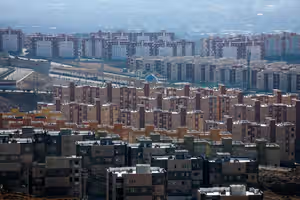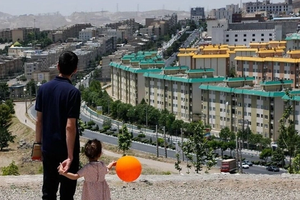
Around 20,400 people participated in the online poll, with 44% saying they would not invest in property in Iran even if they could afford to do so. Only around half said they would buy a home.
Of those who participated, 67% were men and 33% women.
People aged 25 to 34 made up the largest group of respondents at 36.6%, followed by those aged 35 to 44 at 30.1%. People aged 45 to 54 accounted for 12.8%, while those aged 18 to 24 made up 11.4%.
Participants also left around 2,000 comments explaining their choices, offering a broader picture of the considerations shaping their decisions.
The responses centered on attachment to Iran, hopes for political change, plans to emigrate, economic hardship and concerns over the security of their savings.
‘If I had enough money, I wouldn't be in Iran’
For many of those opposed to buying a home, having enough money would provide an opportunity to leave Iran rather than invest more heavily in the country.
“If I had enough money, I wouldn't be in Iran at all,” one respondent wrote.
“Having enough money in this situation means having the best life abroad,” another wrote.
The responses mirror the findings of an earlier Iran International Instagram poll in which 83% of participants said they would leave Iran if given the opportunity.
Around 100,000 people participated in that poll over 24 hours. Thousands of comments cited economic problems, social restrictions, political conditions and uncertainty over the future among the reasons for wanting to emigrate.
Some participants in the latest poll associated remaining in Iran with insecurity, sanctions, inflation, power outages and difficulties meeting basic needs, saying they would rather put their money into a more stable country.
One described owning a home as inseparable from the wider conditions in which a person lives.
“A home needs a blue sky above it, a thriving tree with bright green leaves in its yard, air without lead coming through its windows, a meal in its kitchen that doesn't come with guilt or selling your dignity, and peace of mind because you feel safe,” the respondent wrote.
“Home is where I can look at the stars at night without waking up the next morning choked with sadness and humiliation.”
Gold and currency offer a way out
Others focused on the financial risks of property ownership.
Unlike in previous years, when buying a home was widely viewed as a relatively secure investment for the future, some said they would now prefer to keep their wealth in gold or foreign currency because those assets are more liquid and easier to take out of the country.
“Investing in a bankrupt economy is certainly a mistake because prices are unrealistic, artificial and like a hollow bubble,” one respondent wrote.
Housing has for years served as a means of preserving wealth in Iran's chronically inflationary economy, and property can provide protection against inflation over the longer term.
But international reporting has also documented a move toward assets that can be carried and quickly converted into cash during periods of uncertainty.
The Associated Press described the trend as a turn toward “portable wealth” during the 12-day war, while the World Gold Council recorded a sharp increase in investment demand for gold in Iran in 2025.
The poll comes as Iranians continue to contend with high inflation. Iran's Statistical Center put year-on-year inflation in July at nearly 88%.
‘I wouldn't trade Iran for anywhere’
For respondents who said they would buy a home, attachment to Iran and a sense of national identity emerged as leading reasons.
Some described owning a home as more than a financial investment, linking it to family, personal history and their connection to the country.
“Yes, I wouldn't trade Iran for anywhere in the world,” one wrote.
“Iran is our mother; you don't abandon your mother when times are difficult,” another wrote.
Others said the country's problems would not persuade them to build a life elsewhere.
“Iran is my first and last choice. I believe good days are ahead of us,” one participant wrote.
Some would buy only after political change
A number of respondents made their willingness to buy a home conditional on political change, greater freedoms or improvements in the country's circumstances.
“When Iran is free, 100%,” one wrote. “After Iran is free, yes, but not under these conditions,” another wrote.
Others questioned the premise of the poll itself, saying the prospect of having enough money to purchase a home was increasingly detached from the economic reality facing many people.
They pointed to difficulties paying for food, rent, medical treatment and other daily necessities, describing home ownership as an unattainable aspiration.
“We are renters, and we'll take the dream of buying a home to the grave,” one respondent wrote.
The findings follow another Iran International Instagram poll in which 90% of respondents said they did not want to marry or have children.