



The alleged killing of a Hindu family of four in Rangpur, Bangladesh, after a retired schoolteacher confronted two young men over their use of yaba has put the spotlight on a synthetic drug whose reach extends across Southeast Asia, Bangladesh and India’s Northeast. According to reports, police say the two suspects allegedly strangled the family members after being confronted while using yaba on the rooftop of their home.
The victims were identified as former Rangpur Zilla School teacher Ganapati Chakraborty, 65, his wife Pritilata Chakraborty, 50, their daughter Agami Chakraborty and son Ayush Chakraborty. Police recovered their bodies from the family’s home in Machuapara, Rangpur city, on Saturday night.
Two cousins, Siddhartha Das, 19, and Mugdha Das, 23, were detained early Sunday, according to the account shared by Prothom Alo and police.
According to Rangpur Police Commissioner Mohammad Abdul Mabud, the two men allegedly climbed onto the roof of the family’s under-construction three-storey house from a neighbouring building on Thursday night and began taking yaba. Ganapati allegedly went upstairs after hearing noises and objected. Police say he was strangled with a towel.
His wife allegedly came towards the rooftop after hearing him, followed by their daughter, while their son was sleeping inside. All four were allegedly killed.
Police also said the suspects remained inside the house after the killings, bathing there, eating dates and cucumbers and continuing to consume yaba.
They allegedly scattered clothes and household belongings to make the deaths appear connected to a robbery and took the victims’ mobile phones, placing them in detergent-mixed water, apparently to destroy evidence. Items allegedly used to consume yaba were also found.
The case does not establish that yaba caused the killings. The police allegation is that the confrontation over its use preceded the murders.
But the incident brings light to a drug that has been described by the United Nations Office on Drugs and Crime as “crazy medicine” and whose use has grown into a major public-health and trafficking problem in Bangladesh.
The trafficking geography forms a chain: production concentrated in Myanmar, movement through the Northeast, and onward distribution into Bangladesh and elsewhere.
The Rangpur killings bring that regional story back to its most immediate consequence. A drug that began as a cheap stimulant for workers and later spread into youth culture has evolved into a major illicit market, leaving behind addiction, health complications, organised trafficking and, in the latest case, allegations of a confrontation that ended with four members of one family dead.
What is yaba?
Yaba is a tablet-form stimulant made principally from methamphetamine and caffeine. A 2008 UNODC report said tablets typically contained about 30 per cent methamphetamine and described the drug as a powerful central nervous system stimulant.
The UN agency said users can experience a burst of energy, heightened activity, reduced appetite and a feeling of wellbeing before the effects wear off. Long-term abuse can lead to tolerance and dependence, while excessive doses can result in convulsions, seizures and death from respiratory failure, stroke or heart failure. UNODC also noted associations between yaba use, aggressive or violent behaviour and psychiatric disorders.
A 2024 medical report from Northeast India described yaba as containing about 30 per cent methamphetamine and 60–70 per cent caffeine, and said its effects can last eight to 12 hours.
The report documented a 34-year-old man from rural Assam who had taken six to eight pills a day for six months. His withdrawal symptoms included severe abdominal pain, nausea, body ache, low mood, poor concentration and loss of appetite. After treatment, he remained abstinent at his first monthly follow-up, although low mood and loss of interest persisted.
From the Golden Triangle to Bangladesh
The drug’s wider story begins in Southeast Asia. The Golden Triangle, where Thailand, Myanmar and Laos meet, is one of the world’s major production zones for synthetic drugs such as methamphetamine.
Myanmar is repeatedly identified as the principal source of yaba reaching Bangladesh, with The Diplomat reporting in 2019 that many production laboratories were concentrated in Shan State, while there were indications of production elsewhere, including Rakhine and Sagaing.
For India, the Northeast has emerged as an important transit corridor between Myanmar and Bangladesh. The Diplomat identified two active routes: one through Mizoram, originating around Champhai, and another through Manipur, which borders Myanmar’s Sagaing region. Seizures in Assam, Meghalaya and Tripura indicated multiple routes and exit points.
The geography makes enforcement difficult. India shares a 1,880-km border with Bangladesh, running through hills, plains and rivers, while gaps in fencing provide opportunities for traffickers. The report said consignments could change hands several times, with different groups operating at different stages of the journey. It also cited Indian officials who believed gangs involved in smuggling gold and heroin were also being used for yaba and “World Is Yours”.
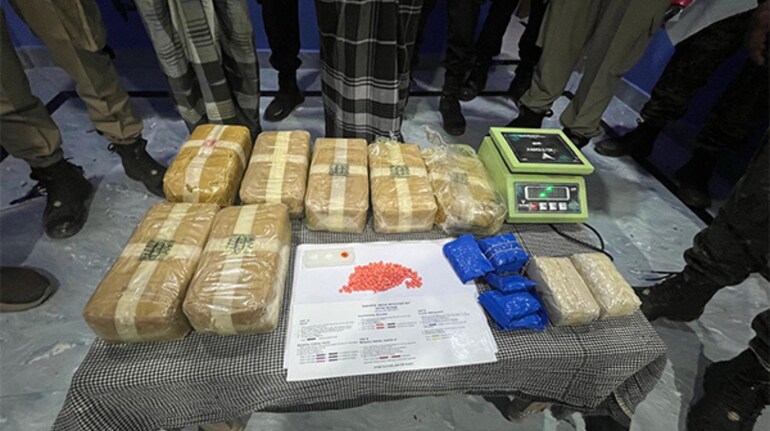
Recent seizures show the corridor remains active. In June 2026, security forces seized 4 lakh yaba tablets worth about Rs 47 crore in Manipur’s Jiribam district. Assam Chief Minister Himanta Biswa Sarma said in July that drugs from Myanmar enter Assam through Mizoram and Manipur before moving towards West Bengal and elsewhere. He said authorities seize only about 20% of the drugs passing through Assam, highlighting the scale of the enforcement challenge.
Bangladesh’s long yaba problem
Yaba first appeared in Bangladesh around 2002, according to a 2019 BBC report. Its availability expanded rapidly, particularly through the southeast, where Bangladesh shares a porous border with Myanmar.
In 2007, UNODC recorded 1.2 million yaba tablets confiscated in Bangladesh. By 2018, Bangladeshi authorities had seized 53 million tablets, while the illicit trade was estimated to be worth more than $1 billion a year.
A BBC investigation in 2019 described hundreds of thousands of people as having become dependent on yaba. One user, Mohammed, recalled staying awake for “seven, eight, even 10 days at a time” while repeatedly consuming the drug, before crashing into prolonged periods of sleep.
Psychiatrist Ashique Selim told the BBC that yaba initially made users feel more sociable and energetic, but warned: “It’s a very, very dangerous drug.”
The government response has also been severe. A 2018 anti-drug crackdown resulted in hundreds of deaths. The BBC reported nearly 300 deaths in the first seven months of the campaign, while the Irish Times, citing Amnesty International, said 466 people were killed that year and tens of thousands arrested.
Addiction crisis continues
Recent reporting suggests enforcement has not ended the demand.
The United Kingdom's publication The Telegraph reported in June this year that more than one million yaba pills were confiscated in separate operations around Cox’s Bazar in April. It said the Central Drug Addiction Treatment Centre in Dhaka was treating predominantly yaba users.
The report estimated 2.3 million yaba users in Bangladesh and described patients who had begun taking the drug as teenagers. One 23-year-old, Shafi, said he once remained awake for seven days and eventually began using heroin, fentanyl and morphine to come down from yaba-induced sleeplessness.
Another patient, Sifat, described becoming aggressive and attacking people. A 17-year-old patient, Amin, said he began using yaba during adolescence and eventually stole from home to finance his consumption.
Resident psychiatrist Dr Mohammed Rahanul Islam said yaba had “destroyed our social architecture” and described combinations of yaba with other synthetic opioids as a “poor man’s speedball”.
The Irish Times reported in July that Bangladesh’s mental-health system is struggling alongside the addiction crisis. Psychiatrist Dr Md Arifuzzaman said the country has only about 350 psychiatrists and cited a national survey finding that around 90 per cent of people requiring mental healthcare did not seek treatment.
Menace in Northeast
The problem is not confined to Bangladesh.
In June 2026, Assam Rifles and other security agencies seized 4 lakh yaba tablets worth about Rs 47 crore in Manipur’s Jiribam district. A Bihar resident driving the vehicle was arrested, while investigators sought to establish the consignment’s source and destination.
A month later, Assam Chief Minister Himanta Biswa Sarma said Assam was being used as a transit route for drugs originating in Myanmar, moving through Mizoram and Manipur towards West Bengal and other parts of India. Assam had seized drugs worth Rs 3,327 crore over five years, he said, while authorities were able to intercept only about 20 per cent of drugs moving through the state.